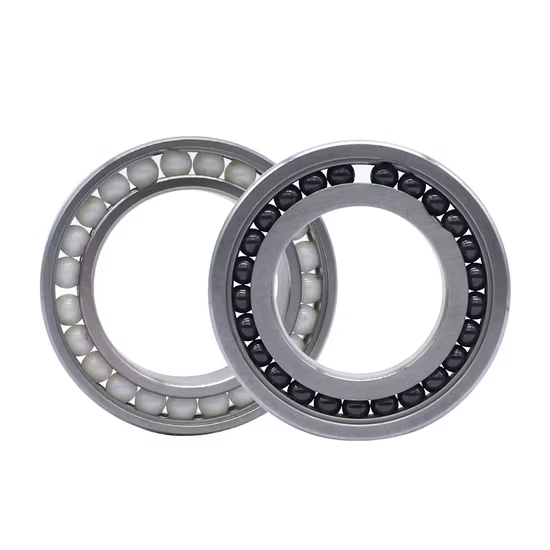
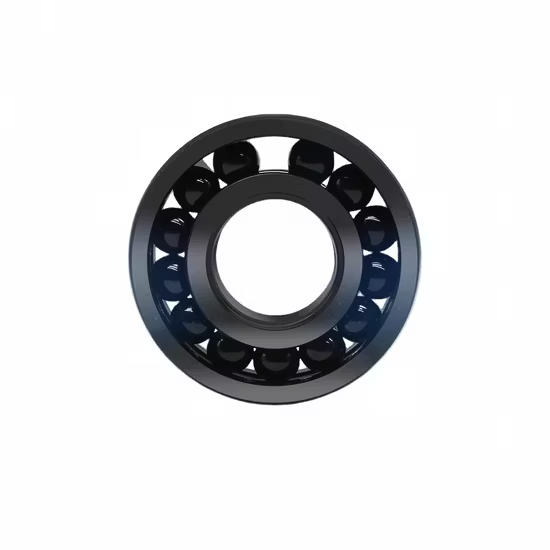
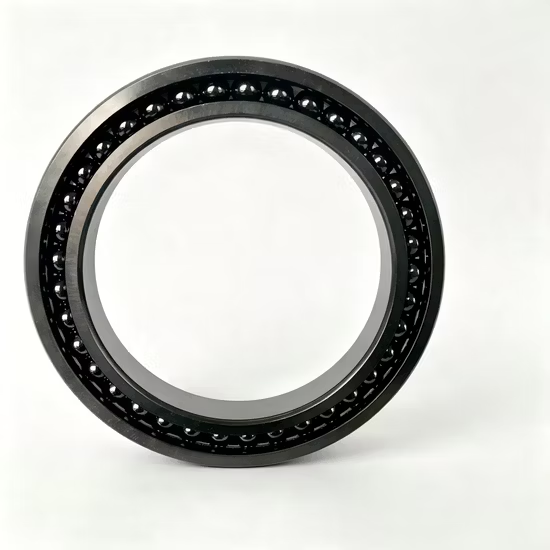
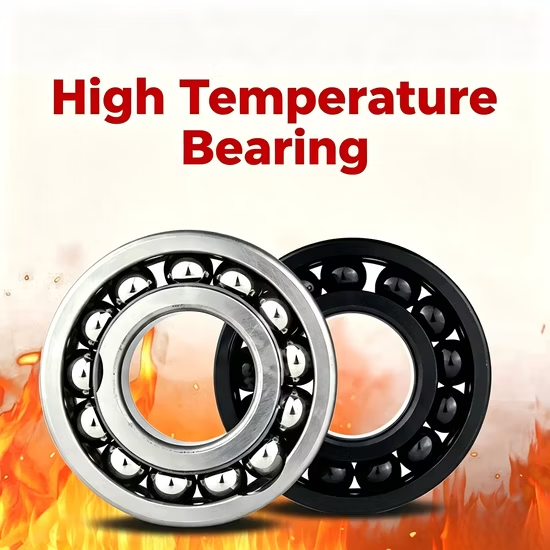
Cross-Reference Triad Alignment — verifying internal clearance, cage metallurgy, and thermal expansion coefficients simultaneously to prevent catastrophic seizure in extreme heat zones.
Technical Specifications
| Parameter |
Value |
| Product Type |
High Temperature Roller Bearing |
| Material Options |
Available in specialized heat-resistant bearing steel or high-temperature alloy variants |
| Operating Temperature Range |
Up to 400°C |
| Operational Features |
Corrosion resistant, antimagnetic, high-speed capable, heavy load capacity, heat resistant |
| Certification |
RoHS, CE |
| Customization |
Available for specific dimensional and configuration requirements |
Application Suitability
| Industry |
Typical Applications |
| Steel and Metallurgy |
Continuous casting machine guide rolls, ladle turret slewing mechanisms, cooling bed transfer rollers |
| Industrial Machinery |
High-heat drying cylinders, industrial furnace conveyor drives, calcination kiln support wheels |
Why Standard Bearings Seize in 400°C Metallurgy Zones Before the Steel Melts
Thermal expansion rapidly eliminates internal clearance in standard bearings, causing the rolling elements to bind and weld to the raceways long before the surrounding structural steel loses its integrity.
Witnessing a standard clearance bearing seize inside a Dubai steel mill reveals the brutal reality of extreme heat environments. The inner ring often anneals and turns blue, a clear indicator of catastrophic thermal binding caused by ignoring the massive expansion differentials between the shaft, housing, and rolling elements. Sourcing from a reliable high temperature roller bearing supplier ensures that the internal geometry is specifically calculated to maintain operational clearance when the ambient and frictional heat push the assembly to its absolute thermal limits [NEED_CITE: thermal binding failure mechanisms in high-heat rolling elements]. Relying on basic designation matching without verifying the thermal expansion coefficients of the specific cage and ring materials guarantees premature, unplanned downtime in continuous casting and ladle turret applications.

Matching Bearing Metallurgy to Extreme Thermal Environments
Selecting the correct high temperature roller bearing requires looking far beyond the basic outer dimensions to evaluate how the internal components react to sustained 400°C operation. We cross-reference the specific thermal growth rates of the shaft and housing materials against the bearing’s internal geometry to ensure the clearance never collapses under peak operating temperatures. This precise application-based selection prevents the rolling elements from skidding and generating excessive frictional heat, which is a primary cause of cage failure in metallurgy plants.
Navigating Heavy Loads and Thermal Gradients in Furnace Zones
The environment inside a steel mill subjects mechanical components to severe combined loading, where heavy radial forces from the roll weight intersect with axial thrust from material misalignment. These immense loads are compounded by steep thermal gradients that degrade standard lubricants and alter the dimensional stability of the bearing housing. Proper selection must account for the specific heat dissipation characteristics of the installation zone, ensuring that the chosen material variant maintains its structural hardness and fatigue resistance without suffering from localized softening [NEED_CITE: rolling bearing failure mode classification per ISO 15243]. Furthermore, the exposure to metallic dust and cooling water spray demands a configuration that resists both abrasive contamination and rapid corrosion.
Decoding Material Options for Sustained High-Heat Operation
The core performance of these components relies on the specific material variants chosen to withstand the operational environment. While standard bearing steel rapidly loses its hardness and dimensional stability at elevated temperatures, specialized heat-resistant bearing steel variants are engineered to retain their structural integrity and load-carrying capacity up to 400°C. For applications involving aggressive cooling sprays or corrosive flux residues, stainless steel or specialized alloy options provide the necessary corrosion resistance without sacrificing heavy load capability. The selection between these material options depends entirely on the specific balance of thermal exposure, corrosive agents, and mechanical stress present at the installation site.
The Hidden Costs of Ignoring Thermal Expansion Dynamics
Installing a component with standard internal clearance in a high-heat zone inevitably leads to thermal binding, where the expanding shaft eliminates the operational gap and forces the rolling elements to slide rather than roll. According to the failure analysis frameworks outlined in ISO 281 and ISO 15243, this skidding action generates immense localized friction, rapidly destroying the cage and scoring the raceways. The resulting catastrophic damage not only destroys the bearing but frequently scores the expensive shaft and housing, turning a simple component replacement into a major, multi-day machinery rebuild that voids equipment warranties and halts production.
Securing Genuine Components for Critical Metallurgy Infrastructure
Our procurement channels guarantee that every unit is sourced directly from authorized manufacturers, completely eliminating the risk of counterfeits with soft inner rings that fail instantly under extreme heat. We provide comprehensive cross-reference alignment that verifies the internal clearance and cage materials are specifically matched for 400°C thermal expansion, rather than just matching the basic outer dimensions. Every shipment includes full batch traceability and material test reports, allowing your maintenance team to verify the exact heat treatment and steel grade before installation. This rigorous documentation process ensures that the specific heavy-load and high-speed configurations required for your continuous casters are met with verified, authentic components.
Documentation & Authenticity
- Certificate of Conformity confirming CE and RoHS compliance for global metallurgy equipment standards.
- Original manufacturer batch and lot traceability linking each unit to its specific heat treatment cycle.
- Official brand app QR verification to instantly authenticate the origin of every heat-resistant component.
- Material test reports verifying the specific high-temperature alloy grade and structural integrity.
- Dimensional and running accuracy inspection reports confirming tolerance adherence before dispatch.
- Country-of-origin documentation ensuring full supply chain transparency for international procurement.
Storage, Handling & Mounting Protocols
- Store the heat-resistant bearing steel variants in their original, unopened packaging to prevent surface oxidation before installation.
- Use clean, lint-free thermal gloves when handling to avoid transferring moisture that could compromise the high-temperature surface finish.
- Apply controlled induction heating for mounting, strictly monitoring the temperature to avoid exceeding the 400°C operational limit during installation.
- Ensure the mounting environment is free from metallic dust and cooling water spray to protect the corrosion-resistant surfaces.
- Verify the specific heavy-load alignment parameters during installation to prevent uneven stress on the high-speed capable rolling elements.
Engineering Support for Precise Application Matching
To ensure the selected components perfectly match your specific metallurgy equipment, please provide the exact equipment model, installation space constraints, and the detailed load and speed parameters. Our engineering team will utilize this operational data to determine the precise internal configuration and material variant required for your unique thermal environment. Supplying information regarding specific environmental exposures, such as corrosive fluxes or extreme dust levels, allows us to finalize the optimal material and protection strategy for your application.
Frequently Asked Questions
Q: How do we determine the exact bearing designation for our specific furnace equipment?
A: Determining the precise designation requires a detailed analysis of your equipment’s radial and axial loads, operating speeds, and the exact thermal expansion characteristics of the shaft and housing. By providing these specific operational parameters, our engineering team calculates the necessary internal clearance and selects the appropriate material variant to ensure reliable performance without thermal binding in your specific high-heat environment.
Q: What are the most common failure modes of standard bearings in steel mill applications?
A: Standard bearings typically fail in metallurgy plants due to thermal binding, where extreme heat causes the shaft to expand and eliminate the internal clearance. This forces the rolling elements to skid rather than roll, generating excessive friction that rapidly destroys the cage and anneals the inner ring. Other frequent failure modes include lubricant degradation and abrasive wear from metallic dust infiltrating the internal geometry.
Q: How do material selection boundaries differ between standard steel and high-temperature alloys?
A: Standard bearing steel rapidly loses its structural hardness and dimensional stability when exposed to sustained high heat, leading to premature deformation and seizure. In contrast, specialized heat-resistant bearing steels and high-temperature alloys are engineered with specific metallurgical compositions that retain their fatigue strength and hardness at elevated temperatures. The boundary is defined by the maximum continuous operating temperature and the presence of corrosive elements in the environment.
Q: Why must internal clearance be adjusted specifically for 400°C operations?
A: At 400°C, the thermal expansion of the bearing rings, rolling elements, shaft, and housing occurs at vastly different rates due to their varying masses and material properties. If standard clearance is used, the differential expansion will completely close the internal gap, causing the components to bind and seize. The clearance must be specifically increased during manufacturing to compensate for this exact thermal growth and maintain a safe operational gap.
Q: What certification requirements apply when importing these industrial components?
A: Importing industrial components for heavy machinery typically requires compliance with international safety and environmental standards, such as CE marking for European markets and RoHS compliance for restricting hazardous substances. Additionally, procurement teams often require comprehensive material test reports and certificates of conformity to verify that the specific high-temperature alloys and manufacturing processes meet the stringent quality demands of the global metallurgy industry.