Full Batch Traceability — Every high-temperature ceramic component ships with manufacturer lot tracking and official QR verification.
Technical Specifications
| Parameter |
Value |
| Product Type |
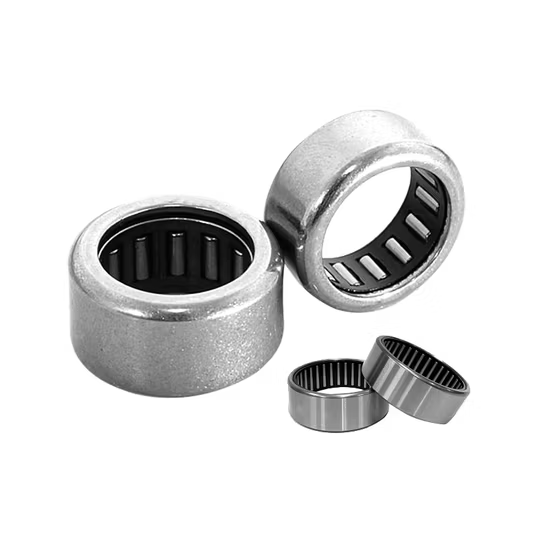
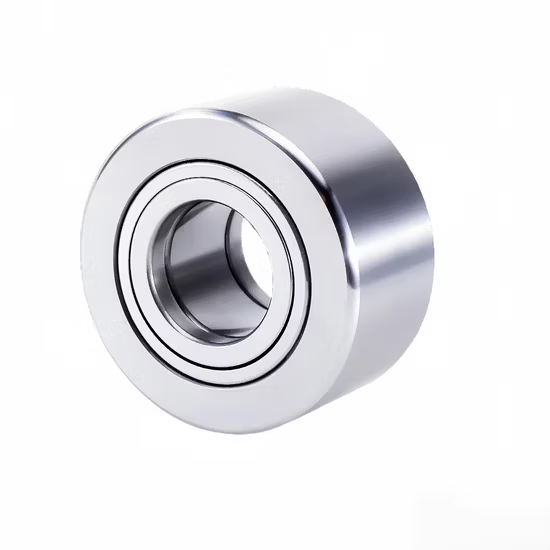
Thrust Needle Roller Bearing |
| Material |
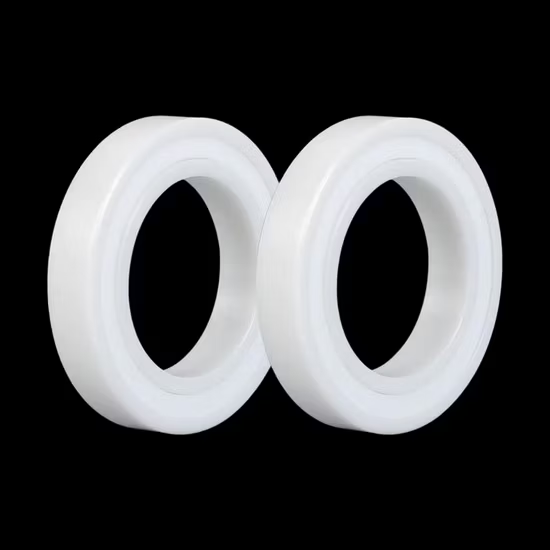
Available in ceramic or specialized high-temperature steel variants |
| Vacuum Compatibility |
High Vacuum Compatible |
| Operating Temperature Range |
Up to 800℃ |
| Precision Class |
P4/P5 |
| Customization |
Application-specific internal geometry and cage design |
Application Suitability
| Industry |
Typical Applications |
| Robotics |
Articulation joints and rotary actuators in high-heat automated welding arms |
| Semiconductor Equipment |
Wafer transfer mechanisms and vacuum chamber rotational stages |
| Material Handling |
High-temperature conveyor drives and continuous furnace roller supports |
Overcoming Thermal Binding in Extreme Robotics Environments
Sourcing from a qualified high temperature ceramic thrust needle roller bearing supplier prevents catastrophic thermal binding when standard steel components exceed their metallurgical limits.
Thermal expansion mismatches and cage degradation are the primary culprits behind sudden joint lockups in high-heat robotics.
During field troubleshooting in Dubai, I investigated a robotic arm that repeatedly seized under heavy operational loads. The root cause was not the load itself, but a standard thrust bearing installed in an environment far beyond its thermal threshold. The internal clearance vanished as the steel expanded, and the cage deformed under extreme heat, leading to immediate mechanical lockup. Relying on basic designations while ignoring material limits and precision suffixes causes a significant share of premature failures in automated systems [NEED_CITE: rolling bearing failure mode classification per ISO 15243]. When equipment operates near continuous high-heat sources, standard components simply cannot maintain their dimensional stability.

Aligning Material Options with Vacuum and Heat Demands
Selecting the right high temperature ceramic thrust needle roller bearing supplier ensures your automated systems receive components matched to their exact thermal and environmental profiles. We evaluate the specific heat transfer rates and vacuum requirements of your robotic joints to recommend the optimal material variant. Our technical team reviews the operational boundaries to ensure the selected bearing maintains structural integrity without outgassing in sensitive semiconductor processing chambers.
Navigating Axial Loads and Thermal Expansion Dynamics
Thrust needle roller bearings in conveyor systems and robotic joints primarily manage heavy axial loads while enduring severe thermal gradients. At elevated temperatures, standard lubricants degrade rapidly, necessitating specialized high-temperature greases or solid lubricant alternatives. The internal clearance must be carefully calculated to accommodate the thermal expansion of both the bearing and the surrounding housing. In high-vacuum semiconductor environments, the absence of convective cooling further complicates heat dissipation, making the thermal conductivity of the chosen material variant a critical factor in preventing localized overheating [NEED_CITE: thermal management in vacuum environments per ISO 281].
Evaluating Ceramic and Steel Variants for Extreme Duty
The choice between ceramic and specialized steel variants dictates the operational ceiling of your thrust needle roller bearings. Ceramic options provide exceptional dimensional stability and high vacuum compatibility, making them ideal for semiconductor wafer handling where outgassing is strictly prohibited. Conversely, advanced high-temperature steel variants offer superior shock load resistance for heavy-duty conveyor drives. Selecting the appropriate precision class, such as P4 or P5, ensures tight running accuracy, which is vital for minimizing vibration in sensitive robotic articulation joints. The correct material and precision combination directly influences the fatigue life and operational smoothness of the entire automated assembly.
The Downtime Penalty of Incorrect Material Selection
Installing a standard steel thrust bearing in an 800℃ robotic joint inevitably leads to rapid thermal degradation and catastrophic mechanical failure. The resulting unplanned downtime halts entire production lines, causing severe financial penalties and delayed shipments. Furthermore, the sudden disintegration of a seized bearing can scatter debris into sensitive semiconductor cleanrooms, leading to massive contamination cleanup costs. According to failure analysis frameworks, utilizing components outside their specified thermal boundaries voids equipment warranties and accelerates the wear of adjacent drivetrain components [NEED_CITE: bearing failure analysis and warranty implications per ISO 15243].
Securing Genuine High-Temperature Components
Mixed-brand procurement often results in mismatched clearances, but our authorized coverage ensures every high-temperature thrust bearing meets exact OEM thermal specifications. Cross-reference errors frequently overlook vacuum compatibility; we verify material certifications to guarantee no outgassing in your semiconductor chambers. Standard distributors might supply P0 grade parts for precision robotics, whereas we strictly validate P4/P5 running accuracy for your sensitive joints. Batch traceability is often missing in extreme-duty parts, yet we provide full manufacturer lot tracking for every ceramic variant. When unusual heat profiles arise, our application-based selection review prevents the cage deformation failures I frequently witness in the field.
Documentation & Authenticity
- Certificate of Conformity verifying high-temperature material grades for vacuum compatibility.
- Manufacturer batch and lot traceability with QR verification via official brand apps.
- Material test reports confirming ceramic composition and 800℃ thermal ratings.
- Dimensional and running accuracy inspection reports validating P4/P5 precision claims.
Storage, Handling & Mounting
- Store ceramic variants in original packaging to prevent microscopic edge chipping before robotic joint assembly.
- Use cleanroom-compatible gloves when handling high vacuum compatible bearings for semiconductor transfer mechanisms.
- Avoid carbon steel tooling during mounting to prevent cross-contamination on ceramic thrust surfaces.
- Verify high-temperature grease compatibility before relubricating conveyor drive bearings operating near 800℃.
- Maintain strict climate control in storage to protect P4/P5 precision tolerances from ambient humidity corrosion.
Engineering Support for Complex Thermal Profiles
To ensure optimal performance in extreme environments, please provide your specific equipment parameters, including continuous axial loads, rotational speeds, and peak operating temperatures. Our engineering team will utilize this data to determine the exact bearing designation and internal clearance required for your robotic or conveyor application. Detailing the environmental conditions, such as high vacuum or corrosive atmospheres, allows us to specify the precise material variant and lubrication strategy for your system.
Frequently Asked Questions
Q: How do you determine the exact bearing designation for high-heat robotic joints?
A: We analyze your specific axial loads, rotational speeds, and peak operating temperatures to calculate the required internal clearance and material variant. By understanding the thermal expansion characteristics of your housing, our engineering team specifies the exact designation needed to prevent thermal binding and ensure reliable operation in extreme environments.
Q: Why do standard steel bearings fail in semiconductor vacuum chambers?
A: Standard bearing steel loses dimensional stability at elevated temperatures and often utilizes lubricants that outgas, contaminating sensitive vacuum environments. Ceramic variants maintain structural integrity under extreme heat and offer high vacuum compatibility, preventing the premature cage deformation and thermal lockups commonly seen when standard materials are pushed beyond their metallurgical limits.
Q: How do ceramic and steel variants compare for high-temperature conveyor drives?
A: Ceramic options excel in applications requiring extreme dimensional stability and high vacuum compatibility, resisting thermal degradation exceptionally well. Specialized high-temperature steel variants, however, offer superior resistance to heavy shock loads. The selection depends on balancing the specific heat profile, load characteristics, and maintenance intervals of your conveyor system.
Q: What precision class is required for automated robotic articulation joints?
A: Robotic joints typically demand P4 or P5 precision classes to ensure tight dimensional and running accuracy. This minimizes vibration and ensures smooth, repeatable movement, which is critical for automated tasks. Using lower precision grades in these sensitive applications often leads to positional errors and accelerated wear under continuous dynamic loading.