Multi-Brand Authorized Coverage — Consolidate your heavy machinery maintenance orders with genuine FAG, SKF, and NTN spherical plain bearings in a single shipment, eliminating multi-vendor coordination delays.
Technical Specifications
| Parameter |
Value |
| Designation |
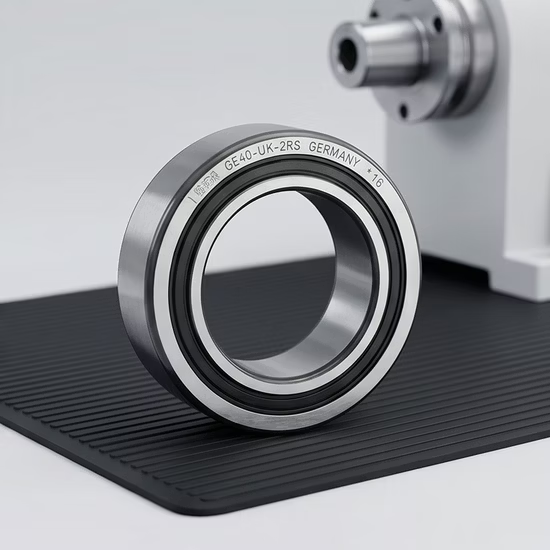
FAG GE240-DO-2RS |
| Bearing Type |
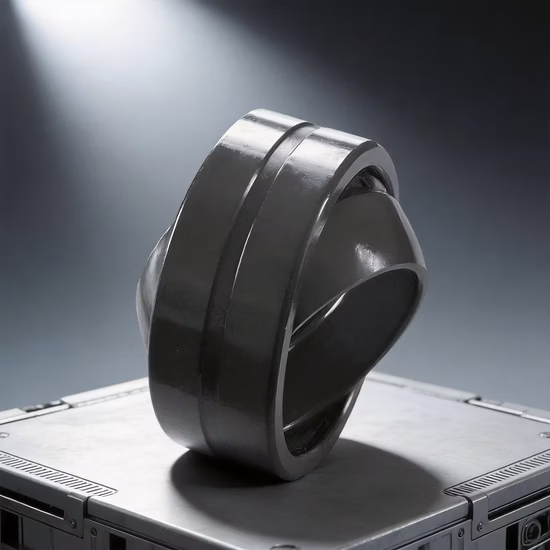
Spherical Plain Bearing |
| Bore Diameter (d) |
240 mm |
| Outside Diameter (D) |
340 mm |
| Ball Diameter (dk) |
300 mm |
| Width (B) |
140 mm |
| Material |
Bearing Steel |
| Precision Class |
P0 |
| Seal or Shield Type |
Double contact seals (2RS) |
| Lubrication |
Maintenance-free PTFE |
Note: The DO suffix generally denotes an outer ring featuring lubrication grooves and holes combined with seals, but exact dimensional execution requires manufacturer catalog confirmation for this specific production batch.
Application Suitability
| Industry |
Typical Applications |
| Mining and Crushing |
Articulation joints in heavy haul trucks and primary crusher toggle plates |
| Steel and Metallurgy |
Continuous casting machine oscillating mechanisms and ladle transfer cars |
| Cement Production |
Rotary kiln support roller adjustment linkages and clinker cooler drives |
| Heavy Material Handling |
Slewing mechanism pivot points in stacker reclaimers and ship loaders |
Why Sealing Integrity Dictates Survival in Dust-Heavy Environments
Visual matching of the base number is irrelevant when the sealing geometry fails to block particulate ingress.
During a turnaround at a cement plant in Dubai, I inspected a rotary kiln support linkage that had seized completely. The maintenance team had replaced the original joint bearing with a visually identical alternative, but the substitute lacked the specific outer ring lubrication channel and double contact seal configuration. Within weeks, fine clinker dust bypassed the inadequate sealing lip, embedding itself into the sliding contact surface and causing catastrophic galling [NEED_CITE: rolling bearing failure mode classification per ISO 15243]. When sourcing a FAG GE240-DO-2RS spherical plain bearing, verifying the exact seal profile and outer ring geometry is the only defense against premature structural locking in abrasive atmospheres.

Matching the PTFE Liner to Heavy Oscillating Loads
Selecting the correct maintenance-free design ensures that the sliding interface withstands slow, heavy oscillations without relying on external grease injection. The integrated PTFE fabric liner provides continuous lubrication at the contact zone, which is essential for pivot points where manual re-lubrication is physically dangerous or operationally impossible. Our technical review process verifies that the specified maintenance-free compound aligns with your specific load and oscillation frequency, preventing the rapid wear associated with mismatched sliding materials.
Navigating Abrasive and High-Load Operational Realities
Heavy equipment articulation points endure extreme static loads combined with microscopic oscillating movements that prevent the formation of a hydrodynamic lubricating film. In these boundary lubrication regimes, environmental contaminants act as lapping compounds. The double contact seals on this unit are engineered to maintain lip pressure against the inner ring even during slight misalignments, effectively excluding moisture and silica dust [NEED_CITE: environmental contamination effects on plain bearing wear rates]. Without this precise sealing arrangement, the sliding surface degrades rapidly, leading to increased friction torque and eventual seizure of the structural joint.
Decoding the Geometry and Suffix Execution
The core value of this specific configuration lies in the interaction between the 240 mm bore, the 340 mm outer diameter, and the specialized sealing system. The 2RS suffix guarantees double contact seals that physically wipe the inner ring surface during articulation. Meanwhile, the outer ring design facilitates initial factory greasing and provides a pathway for specific break-in procedures if required by the OEM. The bearing steel construction, hardened to standard industry specifications, provides the necessary structural rigidity to handle heavy radial loads without raceway deformation [NEED_CITE: material hardness standards for heavy-duty plain bearings]. Understanding these specific suffix implications prevents the installation of open or single-sealed variants that would fail rapidly in contaminated zones.
The Operational Impact of Incorrect Suffix Selection
Installing a base-number match that omits the correct sealing or outer ring profile leads directly to unplanned downtime and massive secondary damage. When fine particulates breach an incorrect seal, the resulting abrasive wear accelerates exponentially, often destroying the surrounding housing and shafting before the bearing itself is flagged for replacement. Following the failure analysis frameworks outlined in ISO 15243, these incidents are classified as avoidable contamination failures [NEED_CITE: ISO 15243 contamination failure categories]. The resulting equipment stoppage and structural repair costs vastly outweigh the initial investment in the precisely specified component.
Securing Your Supply Chain Against Counterfeit Risks
Procuring critical spares requires more than just matching a part number on a commercial invoice. Our authorized distribution network ensures that every unit is sourced directly from the manufacturer’s production facilities, eliminating the risk of soft inner rings that plague the gray market. We actively cross-reference the 2RS seal specifications and outer ring profiles to guarantee exact OEM interchangeability, rather than relying on superficial catalog matches. Furthermore, our application engineering team reviews your specific load and misalignment parameters to validate the selection before shipment, ensuring the component survives the actual field conditions.
Documentation & Authenticity
- Certificate of Conformity linking the specific batch to the manufacturer’s original production records.
- Official brand app QR verification to instantly authenticate the PTFE liner and sealing specifications.
- Material test reports confirming the bearing steel metallurgical composition and heat treatment parameters.
- Dimensional and running accuracy inspection reports validating the 240 mm bore and 340 mm OD tolerances.
- Country-of-origin documentation required for customs clearance and international project compliance.
Storage, Handling & Mounting
- Retain the factory packaging until the exact moment of installation to protect the 2RS double contact seals from ambient warehouse dust.
- Use clean, lint-free gloves when handling the exposed 300 mm ball diameter surface to prevent moisture-induced corrosion.
- Avoid striking the outer ring during press-fitting to prevent deformation of the lubrication grooves and seal seating areas.
- Ensure the housing is perfectly clean before insertion, as trapped debris will compromise the PTFE sliding interface immediately.
- Do not attempt to force additional grease into the sealed cavity, as over-pressurization will rupture the double contact seal lips.
Engineering Support and Technical Validation
To ensure optimal performance and longevity, please provide the specific radial and axial load profiles, oscillation angles, and ambient operating temperatures of your application. Supplying the exact OEM equipment designation or original drawing numbers allows our engineering team to perform a comprehensive cross-reference check, verifying that the seal geometry and outer ring profile match the housing requirements perfectly. This technical validation ensures the selected component integrates flawlessly into your heavy machinery maintenance schedule.
Frequently Asked Questions
Q: How can we verify the authenticity of the PTFE liner and seals upon delivery?
A: Every unit is supplied with traceable batch documentation and a unique QR code. By scanning this code through the manufacturer’s official application, procurement and maintenance teams can instantly verify the production origin, confirming that the maintenance-free PTFE compound and double contact seals meet exact factory specifications and are not cloned counterfeit copies.
Q: Why is it critical to align the outer ring profile during cross-referencing?
A: Base number matches often ignore outer ring geometry variations. If the replacement lacks the specific lubrication grooves or seal seating profiles required by the OEM housing, it can lead to improper seal compression or blocked lubrication paths, causing rapid contamination ingress and premature joint failure in heavy equipment.
Q: Where is the boundary between maintenance-free and relubricatable designs?
A: Maintenance-free PTFE designs excel in slow, heavily loaded oscillating applications where external grease injection is impossible or where dust would turn grease into an abrasive paste. If the application involves continuous high-speed rotation or extreme thermal cycling beyond standard liner limits, a relubricatable steel-on-steel design with active purging grease might be required.
Q: What failure modes are most common in heavy equipment articulation joints?
A: According to ISO 15243 frameworks, the most frequent failures in these joints stem from contamination and boundary wear. When inadequate seals allow silica or metallic dust to enter the sliding interface, the particulate matter acts as a lapping compound, rapidly destroying the sliding surface and leading to catastrophic seizure of the structural linkage.