
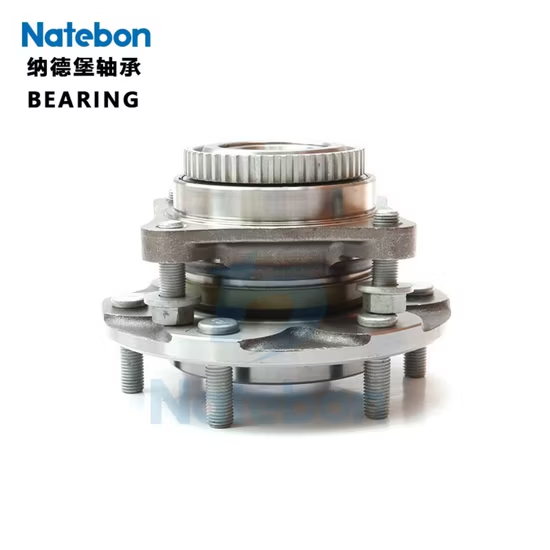
Low Maintenance Wheel Hub Bearing for New Energy Vehicles
View Details
SKF
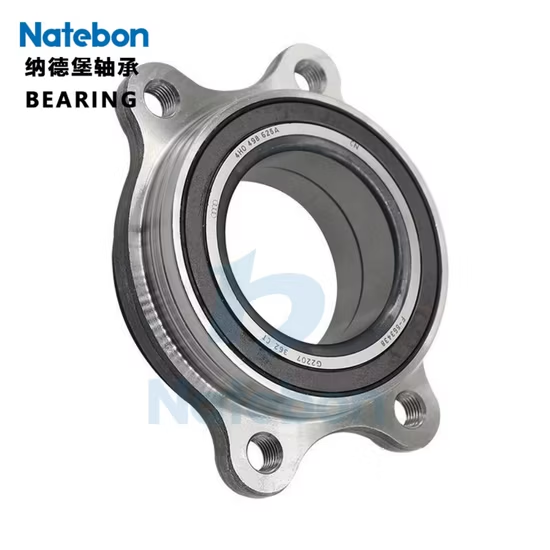
-- SKF Authorized Engineering Partner
Auto Bearing for Third Generation Hub Units and EPS — engineered for diverse passenger vehicles with P0 tolerance ensuring precise steering and wheel end performance.
15+ Certified Engineers On-Call
Free application analysis · Failure diagnosis · Custom modification guidance. Response within 24 hours.
Cross-reference alignment on three critical dimensions — verifying internal seal configurations, flange geometries, and sensor ring specifications rather than relying solely on base part numbers.
| Parameter | Value |
|---|---|
| Product Type | Wheel Hub Bearing |
| Wheel Hub System | 3rd Gen Hub Unit |
| Steering System | EPS Bearings |
| Tolerance Class | P0 |
| Suitable Vehicle Brands | Volkswagen, Benz, BMW, Hyundai, Honda, Toyota, Jeep, Nissan, Ford, Audi, Volvo, Mazda, Kia, and others |
| Origin | China |
| Customization | Available upon request |
| Industry | Typical Applications |
|---|---|
| Passenger Vehicles | Front and rear wheel hub assemblies, electric power steering column mechanisms |
| Commercial Vehicles | Light duty truck wheel ends, fleet maintenance steering gear replacements |
| Automotive Repair & MRO | Suspension system overhauls, steering rack rebuilds, drivetrain servicing |
Internal design discrepancies hidden behind identical base numbers lead to rapid seal degradation and sensor failure.
When sourcing replacement parts for modern passenger and commercial vehicles, procurement teams often rely on basic cross-references. However, matching the outer dimensions while ignoring the internal seal lip design or the ABS sensor ring encoding results in units that fit physically but fail operationally. A hub assembly installed in a high-load cornering application with an incorrect seal profile will ingest moisture and road salt, destroying the grease and raceways within months. This粗放 replacement approach ignores the precise engineering required for modern chassis dynamics, turning a routine maintenance task into a recurring warranty nightmare [NEED_CITE: rolling bearing failure mode classification per ISO 15243].
Selecting the correct auto wheel hub bearing supplier involves more than checking bolt patterns. Third-generation hub units integrate the bearing, hub, and ABS sensor into a single pre-adjusted cartridge, requiring precise alignment with the vehicle’s suspension geometry. Our engineering review ensures the flange offset and pilot diameter match the specific OEM requirements, preventing brake rotor runout and uneven tire wear that plague incorrectly specified aftermarket units.
Electric power steering systems and wheel ends operate under severe thermal and contamination stress. EPS bearings must handle rapid directional reversals and high friction loads without generating excessive heat, demanding specialized grease and low-friction seals. Meanwhile, wheel hub units face constant exposure to water, brake dust, and road debris. Selecting the appropriate seal material and contact lip design is critical to maintaining lubrication integrity and preventing the ingress of abrasive particles that accelerate fatigue [NEED_CITE: seal friction and contamination ingress in automotive chassis components].
The performance of these automotive bearings relies heavily on material selection and manufacturing precision. Third-generation units are typically forged from high-carbon chromium steel, but specific corrosive or high-temperature environments may require specialized coatings or stainless steel variants for certain sub-components. The P0 tolerance class guarantees the dimensional accuracy necessary for proper press-fit and bolted flange mounting, ensuring the bearing operates without induced preload errors. Furthermore, the integration of active or passive ABS encoder rings requires strict magnetic pole pitch consistency, which is verified during the assembly process to prevent erratic brake system warnings.
Installing a hub unit with the wrong ABS encoder or an EPS bearing with incorrect internal clearance triggers a cascade of operational failures. Modern stability control systems rely on accurate wheel speed data; a mismatched sensor ring causes false braking interventions and disables traction control. In steering columns, improper bearing selection leads to notchy steering feel, increased motor current draw, and eventual EPS module failure. These issues result in significant vehicle downtime, voided component warranties, and severe safety liabilities for fleet operators and repair facilities [NEED_CITE: automotive chassis electronic system failure modes related to mechanical tolerances].
We eliminate the guesswork in automotive bearing sourcing by enforcing strict cross-reference protocols. Instead of shipping a generic hub based on a vague chassis code, we verify the exact brake caliper bracket clearance and sensor type required for the specific vehicle trim. Our batch traceability ensures every 3rd gen unit and EPS bearing can be tracked back to its production run, providing the documentation necessary for rigorous quality audits. This technical depth prevents the costly returns and field failures associated with superficial part matching.
To ensure precise fitment and optimal lifespan, please provide the exact vehicle identification number, OEM part numbers, or detailed chassis specifications. Supplying information regarding the specific steering system architecture or wheel end load requirements allows our engineering team to verify internal clearances and seal configurations. This technical data exchange guarantees the proposed hub units and EPS bearings align perfectly with your maintenance or production requirements.
Q: How do I determine the exact hub unit generation required for a specific vehicle model?
A: Identifying the correct generation requires analyzing the vehicle’s suspension design and braking system. First-generation units press into the steering knuckle, while third-generation units feature bolted flanges for both the knuckle and the wheel rotor. Providing the OEM equipment number or the vehicle identification number allows our team to cross-reference the exact flange geometry, bolt pattern, and integrated sensor type required for your application.
Q: What are the common failure modes in automotive wheel hub bearings under heavy loads?
A: Premature failures typically stem from seal degradation allowing moisture and abrasive road debris to contaminate the grease. This leads to spalling on the raceways and eventual cage failure. Additionally, incorrect installation torque on the flange bolts can distort the outer ring, creating uneven load distribution and accelerating fatigue. Proper seal selection and strict adherence to mounting protocols are essential to prevent these issues.
Q: How does material selection impact the performance of EPS bearings in harsh environments?
A: Electric power steering systems demand bearings that can handle rapid directional changes and high friction without generating excessive heat. While standard bearing steel is common, specific environments may require specialized coatings or stainless steel variants to resist corrosion from road salt or humidity. The internal grease formulation and low-friction seal designs are equally critical to maintain smooth steering feel and prevent excessive motor current draw.
Q: Why is cross-referencing OEM equipment numbers critical for avoiding internal design mismatches?
A: Base part numbers often cover multiple vehicle variants with different internal clearances, seal types, or ABS encoder rings. Relying solely on the base number risks installing a hub with an incompatible sensor or an EPS bearing with the wrong friction characteristics. Detailed cross-referencing ensures the internal design, flange offset, and electronic interfaces match the exact requirements of the specific vehicle trim and production year.
Q: What are the replacement indicators and maintenance cycles for 3rd gen hub units?
A: Third-generation hub units are typically sealed and pre-adjusted, requiring no routine maintenance or regreasing. Replacement indicators include abnormal humming or growling noises that change with vehicle speed, steering wheel vibration, or irregular tire wear. Additionally, any illumination of the ABS or traction control warning lights often indicates a failure of the integrated sensor ring, necessitating complete hub assembly replacement.
Main shaft, gearbox, and generator bearings for onshore and offshore wind turbines. Engineered for 20+ year service life.
Crushers, conveyors, and processing equipment bearings designed to withstand shock loads and contaminated environments.
Rolling mill and continuous casting bearings rated for extreme temperatures, heavy loads, and aggressive lubricants.
Hub units, transmission, and electric motor bearings meeting TS 16949 requirements for passenger and commercial vehicles.
Machine tool spindle and robotics bearings with P4/P2 accuracy class for ultra-precise positioning and minimal vibration.
Pumps, fans, compressors, and conveyor systems across all manufacturing sectors requiring reliable, cost-effective bearing solutions.
Official partner since 1998 with direct access to SKF technical resources, genuine products, and engineering expertise.
In-house team provides application design, failure analysis, and predictive maintenance -- reducing bearing failures by 35%.
Every product undergoes rigorous pre-shipment inspection with full documentation for traceability and compliance.
Dedicated account managers and reliable delivery networks ensure on-time supply for enterprise clients worldwide.
Performance Metrics
35%
Failures Prevented
70%
Downtime Reduction
25+
Years Experience
24h
Quote Response
78% of large enterprises prefer suppliers offering integrated technical support and lifecycle services.
Custom bearing selection and system design based on your specific load conditions, speeds, temperatures, and environmental factors.
Root-cause investigation of bearing failures using metallurgical testing, vibration analysis, and operating data review.
IIoT-enabled monitoring with smart sensor bearings for real-time vibration, temperature, and RPM tracking.
Modified bearings with special coatings, seals, tolerances, or materials. Lead time 8-12 weeks from official channels.
Certified engineers available for on-site installation support, alignment checks, and commissioning assistance worldwide.
Long-term service agreements including regular maintenance checks, replacement scheduling, and performance reporting.
Free samples available for orders over $50K
Validated against your KPIs before full production commitment.
-- Get In Touch
Our certified engineers will review your application requirements and provide a detailed quote within 24 hours.
Address
No. 377 Bansongyuan Road, Huangpu District, Shanghai, China
Free Sample Program
Orders over $50K qualify for free product samples
Test against your KPIs before full production commitment. Ask our engineers for details.
Regarding: Customized 3rd Gen Auto Wheel Hub Bearing for EPS and Passenger Vehicles
-- Related Products

SKF Authorized Engineering Partner
Need technical support or a custom solution?
15+ certified engineers ready to help. Response within 24 hours.