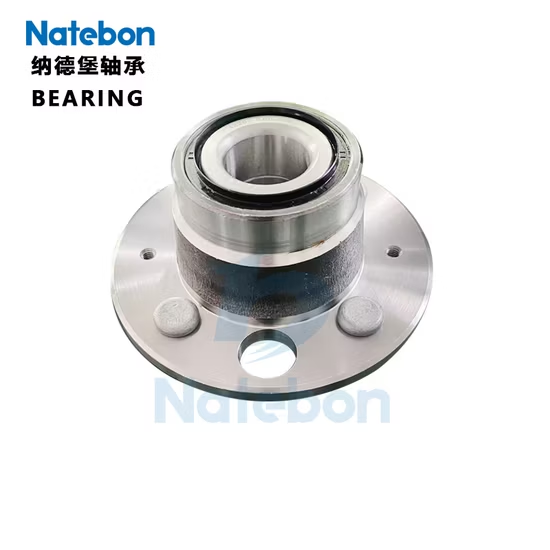
Official App QR Verification — Scan the manufacturer’s QR code directly on the 3rd Gen hub unit packaging to confirm batch authenticity and traceability before installation.
Technical Specifications
| Parameter |
Value |
| Product Type |
Wheel Hub Bearing |
| Precision Class |
P0 |
| Hub Unit Generation |
3rd Gen Hub Unit |
| System Application |
EPS (Electric Power Steering) Bearings |
| Compatible Car Brands |
Volkswagen, WuLing, Benz, BMW, Hyundai, Honda, Toyota, Jeep, Nissan, Ford, Buick, Chery, Chevrolet, Cadillac, Geely, Roewe, Audi, Peugeot, Lexus, Volvo, Mazda, Kia |
| Origin |
China |
Application Suitability
| Industry |
Typical Applications |
| Passenger Vehicles |
Front and rear wheel hub assemblies, steering column EPS supports |
| Commercial Fleets |
Light truck wheel ends, delivery van MRO replacement programs |
| Automotive Repair |
OEM-equivalent hub unit rebuilds for independent workshop bays |
Why Base Numbers Fail When Sourcing an Auto Wheel Hub Bearing Supplier
Matching the OEM part number is only the first step; internal seal designs and flange geometries dictate actual field survival.
Purchasing managers often approve orders based solely on basic designation matches, overlooking critical variations in internal raceway profiles and seal lip configurations. In the Shenzhen automotive aftermarket, I have seen countless 3rd Gen hub units fail within a few hundred kilometers simply because the internal preload or sealing arrangement did not match the specific vehicle chassis requirements. These cross-reference errors lead to thermal binding, moisture ingress, and catastrophic wheel end failure [NEED_CITE: rolling bearing failure mode classification per ISO 15243].

Aligning Hub Unit Architecture with Vehicle Dynamics
As a dedicated auto wheel hub bearing supplier, we ensure the 3rd Gen architecture aligns perfectly with the specific load paths of modern unibody and body-on-frame chassis. Our technical review verifies not just the outer bolt patterns, but the internal raceway geometry and ABS sensor ring compatibility. This meticulous cross-referencing prevents the subtle vibration issues and premature wear that frequently plague generic, dimension-only replacements.
Navigating Road Shock and Contamination in Wheel Ends
Wheel ends endure severe combined loading, absorbing both radial vehicle weight and axial cornering forces alongside sudden pothole impacts. Effective sealing is critical in this environment, as road salt, brake dust, and water spray constantly threaten the internal grease supply [NEED_CITE: contamination impact on bearing fatigue life per ISO 281]. Furthermore, the thermal cycles generated by adjacent brake rotors demand greases that resist degradation and seals that maintain lip contact without excessive friction. Selecting the correct seal variant ensures the hub unit survives these harsh operational extremes without overheating or leaking.
Decoding Material and Precision Options for Hub Units
While P0 precision provides the standard dimensional accuracy required for reliable vehicle dynamics, material selection must adapt to specific environmental exposures. Standard bearing steel offers optimal load capacity for normal passenger vehicle applications, whereas stainless steel variants are available for commercial vehicles operating in highly corrosive, salt-heavy coastal or winter-road environments. The 3rd Gen integrated flange design simplifies mounting, but the internal clearance and cage materials must still be matched to the expected thermal expansion and vibration profiles of the target vehicle platform.
The Hidden Costs of Incorrect Hub Unit Selection
Installing a hub unit with mismatched internal clearances or inadequate seal designs inevitably leads to unplanned downtime and premature failure. When the internal preload does not match the OEM specification, the bearing experiences excessive friction, generating heat that degrades * damage often results in catastrophic wheel end separation, voiding vehicle warranties and exposing repair shops to severe liability risks [NEED_CITE: automotive wheel end safety and liability standards].
Why Procurement Teams Trust Our Technical Validation
We cover all major international bearing brands, allowing procurement teams to consolidate mixed-brand fleet requirements into a single, fully traceable order. Our cross-reference matching goes far beyond the base designation, verifying clearance, cage material, and seal types to prevent field failures. Every batch includes verifiable traceability to the manufacturer, ensuring you receive genuine components rather than soft-ringed counterfeits. We also provide application-based selection reviews, analyzing load, speed, and mounting conditions to guarantee the chosen hub unit fits the exact equipment requirement.
Documentation & Authenticity
- Certificate of Conformity confirming P0 precision class for automotive wheel hub applications.
- Batch and lot traceability linking the 3rd Gen hub unit directly to the manufacturer’s production run.
- Official brand app QR verification to instantly authenticate the wheel hub bearing on the workshop floor.
- Dimensional and running accuracy inspection reports validating flange runout and bore tolerances.
- Country-of-origin documentation required for commercial fleet compliance and customs clearance.
Storage, Handling & Mounting
- Keep the 3rd Gen hub unit in its original packaging until installation to protect the integrated ABS sensor ring from physical damage.
- Store P0 precision wheel hub bearings in a climate-controlled environment to prevent condensation inside the factory-sealed cavities.
- Use clean gloves when handling the machined flange surfaces to prevent acidic sweat from initiating corrosion before mounting.
- Apply the exact OEM-specified axle nut torque to establish the correct internal preload for this 3rd Gen architecture.
- Avoid using impact wrenches on the hub assembly, as sudden shock loads can brinell the raceways and compromise the P0 running accuracy.
Engineering Review and Selection Guidance
To ensure precise fitment, please provide the specific vehicle make, model year, and exact OEM equipment numbers for our engineering team to cross-reference. Sharing details about the operating environment, such as exposure to heavy road salt or extreme dust, allows us to recommend the most appropriate seal and material variants. Our technical team will review these parameters to confirm the correct 3rd Gen hub unit generation and internal design before finalizing the quotation.
Frequently Asked Questions
Q: How to determine the exact hub unit generation required for my vehicle application?
A: Identifying the correct generation requires checking the vehicle’s suspension design and mounting interface. First-generation units press into the steering knuckle, second-generation units feature a flange bolted to the knuckle, while 3rd Gen units integrate both the wheel and knuckle flanges. Providing the exact OEM part number or vehicle VIN allows our technical team to verify the precise generation and internal architecture needed for your application.
Q: What are the common failure modes of wheel hub bearings in commercial vs. passenger vehicles?
A: Passenger vehicle hub units typically fail due to moisture ingress and seal degradation, leading to corrosion and noise. Commercial vehicle applications, however, subject the bearings to significantly higher radial loads and severe shock impacts from heavy payloads, often causing raceway spalling and cage fatigue. Understanding these distinct failure modes helps in selecting the appropriate seal design and internal clearance for the specific fleet requirements.
Q: How to cross-reference OEM part numbers accurately without missing internal design variations?
A: Accurate cross-referencing demands looking beyond the basic dimension and part number. You must verify the internal clearance class, the specific seal lip design, and the ABS encoder ring configuration. Relying solely on basic dimensions often results in installing a unit that fits physically but fails thermally or electronically. Our engineering team validates these internal design variations against the original equipment specifications to ensure exact functional equivalence.
Q: How do EPS bearings differ from standard wheel hub bearings in terms of load and precision requirements?
A: EPS bearings operate within the steering column or rack, managing primarily axial and light radial loads while requiring exceptionally low friction and high precision to maintain steering feel. In contrast, standard wheel hub bearings endure massive combined loads and severe road shock. Consequently, EPS bearings prioritize tight clearance and specialized low-friction greases, whereas wheel hub bearings focus on structural rigidity, high load capacity, and robust contamination sealing.