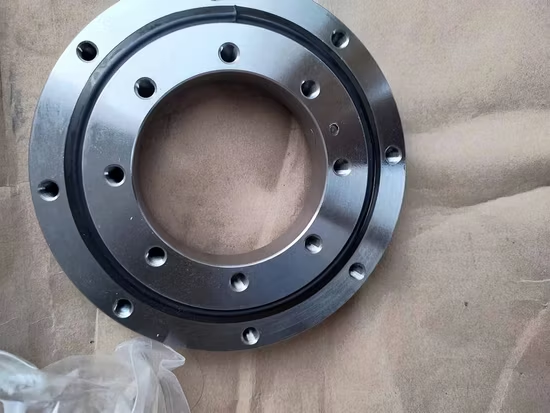
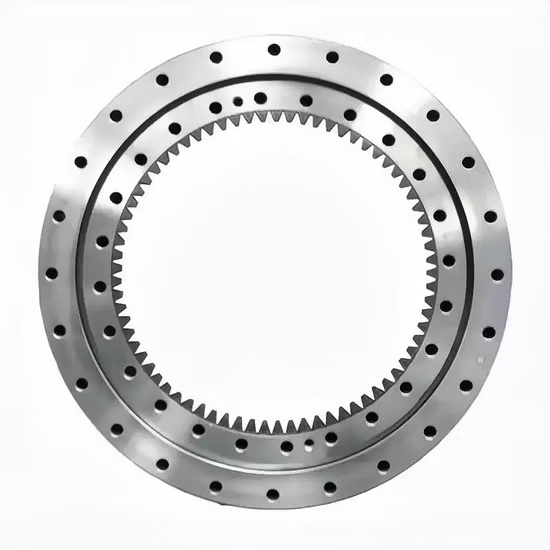
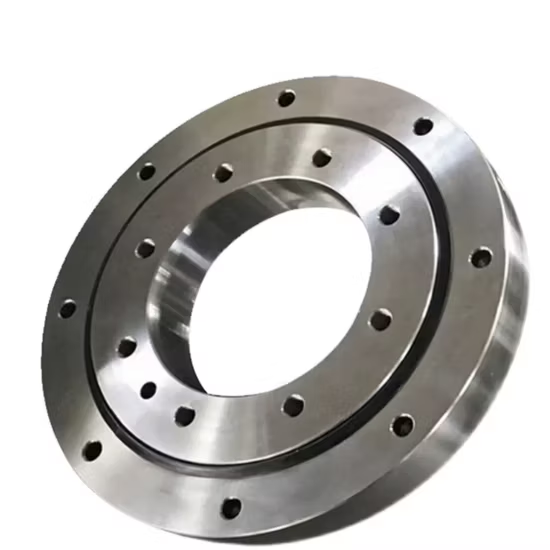
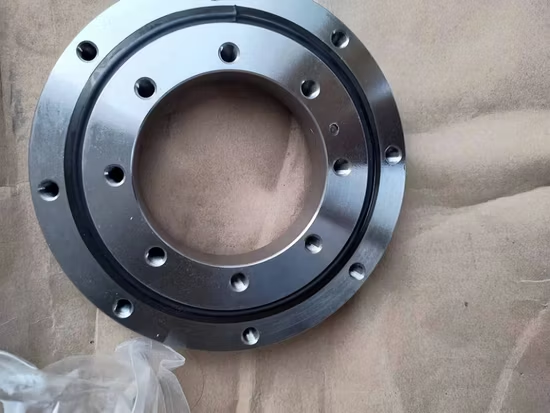
Three-Parameter Cross-Reference Alignment — Matching internal structural configuration, sealing integrity, and load distribution rather than just outer bolt patterns for imaging rotary tables.
Technical Specifications
| Parameter |
Value |
| Product Type |
Slewing Bearing |
| Standard or Nonstandard |
Nonstandard |
| Main Configurations |
Single-Row, Crossed Roller, Three-Row Roller |
| Material Options |
Bearing steel, with stainless steel variants available |
| Environmental Features |
Vacuum, antimagnetic, cold-resistant, corrosion-resistant, heat-resistant options |
| Key Structural Components |
Ring, rolling elements, sealing strip, spacer/cage |
| Core Operational Features |
Large size, low speed, high load capacity |
| Customization |
Available for nonstandard housing dimensions |
| Origin |
China |
Application Suitability
| Industry |
Typical Applications |
| Medical Imaging |
CT scanner gantry rotation, radiotherapy patient positioning tables |
| Automation Systems |
Precision rotary indexing tables, robotic arm base joints |
| Construction & Heavy Machinery |
Crane slewing mechanisms, excavator swing circles |
| Renewable Energy |
Wind turbine yaw and pitch control platforms |
Why Base Dimensions Are Not Enough When Sourcing from a Medical Equipment Slewing Bearing Supplier
Exact outer dimension matching means nothing if the internal structural rigidity and sealing fail under continuous low-speed, high-load imaging cycles.
Procurement teams frequently approve replacement rings based solely on outer diameter and bolt hole patterns, entirely overlooking the specific rolling element configuration required for the application. This dimensional tunnel vision leads to excessive vibration in sensitive diagnostic machines, ultimately compromising image clarity and causing catastrophic damage to adjacent precision components [NEED_CITE: rolling bearing failure mode classification per ISO 15243]. When a standard deep groove ball bearing is mistakenly installed in a high-moment CT rotary table instead of a properly specified cross-roller alternative, the resulting deflection destroys the calibration of the entire imaging array.
Aligning Structural Configurations with Diagnostic Precision
Selecting the correct architecture is the primary responsibility of any reliable medical equipment slewing bearing supplier. A crossed roller design provides the necessary rigidity for imaging gantries that demand zero axial play, whereas a three-row roller configuration handles the massive combined loads found in heavy radiotherapy positioning beds. By evaluating the exact moment loads and space constraints of the machinery, engineers can specify a nonstandard geometry that perfectly integrates with the existing housing without requiring costly structural modifications.
Overcoming Environmental and Operational Extremes
Medical and automation environments impose conflicting demands on rotating components. The slow, continuous rotation of a scanner gantry prevents the formation of a full hydrodynamic lubrication film, making the bearing highly susceptible to boundary friction and wear. Simultaneously, the proximity to powerful magnetic fields and the need for rigorous chemical cleaning dictate strict material choices. Selecting antimagnetic or corrosion-resistant material variants ensures the ring will not interfere with imaging fields or degrade when exposed to hospital-grade sterilization agents [NEED_CITE: tribological challenges in low-speed high-load applications].
Decoding Material and Feature Options
Because these are nonstandard, application-oriented components, material selection is driven entirely by the operational environment rather than a fixed catalog specification. Bearing steel remains the baseline for high load capacity in standard industrial automation, while stainless steel variants are specified when the equipment faces frequent washdowns or corrosive sterilization chemicals. The availability of vacuum-compatible and antimagnetic features ensures that the internal cage materials and sealing strips do not outgas or distort the magnetic fields critical to MRI and advanced CT operations.
The Hidden Costs of Incorrect Structural Selection
Relying on a supplier who only checks base numbers inevitably leads to unplanned downtime and voided equipment warranties. If a single-row configuration is installed where a crossed roller was required, the resulting axial deflection will cause the imaging sensors to misalign, producing unusable diagnostic scans and forcing expensive recalibration. According to failure analysis frameworks like ISO 281, operating a bearing under complex moment loads without the correct internal geometry drastically accelerates fatigue, turning a minor procurement saving into a massive operational liability [NEED_CITE: bearing life calculation methods per ISO 281].
Securing Technical Alignment for Critical Spares
Our approach eliminates the guesswork that plagues standard catalog ordering. We verify the exact rolling element arrangement and sealing requirements to ensure the replacement handles the specific multi-directional loads of your rotary table. Every batch is traced back to the manufacturer’s production facilities, providing full transparency for regulated medical environments. We review the application parameters—such as rotational speed and moment loads—to confirm the selected configuration prevents thermal binding and premature cage failure.
Documentation & Authenticity
- Certificate of Conformity validating the nonstandard dimensional tolerances for custom medical housings.
- Batch and lot traceability linking the specific antimagnetic material heat to the manufacturer.
- QR verification via official apps to confirm the authenticity of the large-diameter rings.
- Material test reports confirming the magnetic permeability of stainless or specialized steel variants.
- Dimensional and running accuracy inspection reports verifying the precise gear and raceway geometry.
- Country-of-origin documentation ensuring compliance with international medical device import regulations.
Storage, Handling & Mounting Protocols
- Keep the large-diameter rings stored flat in their original packaging to prevent gravitational distortion of the nonstandard cross-sections.
- Use clean, lint-free gloves when handling antimagnetic variants to prevent skin oils from compromising vacuum-compatible surface finishes.
- Ensure the sealing strips remain untouched during hoisting to maintain the integrity of the corrosion-resistant barriers.
- Follow strict induction heating protocols for inner ring mounting to preserve the precise clearance required for low-speed CT rotation.
- Avoid using carbon steel tools on stainless steel variants to prevent cross-contamination and localized corrosion spots.
Engineering Your Exact Replacement Specification
To initiate a precise technical review, provide the original equipment manufacturer drawings, existing housing dimensions, and the specific operational loads. Detail the environmental conditions, including any exposure to magnetic fields, vacuum chambers, or sterilization chemicals. Supplying this operational data allows the engineering team to determine the exact rolling element configuration, material variant, and sealing arrangement required for your specific machinery.
Frequently Asked Questions
Q: How do we determine the exact slewing bearing model for a legacy CT scanner?
A: Determining the correct replacement requires more than just measuring the outer diameter. You must provide the exact axial, radial, and moment loads, along with the rotational speed and mounting space constraints. Our engineering team uses these parameters to calculate the required structural configuration, ensuring the selected cross-roller or three-row design matches the original rigidity and precision requirements.
Q: What material options are available for environments requiring frequent chemical sterilization?
A: While standard bearing steel is suitable for most heavy machinery, medical environments often require stainless steel variants to resist harsh cleaning agents. We evaluate the specific chemicals used in your sterilization protocols to recommend the appropriate corrosion-resistant material. This ensures the bearing surfaces and sealing strips maintain their integrity without degrading or contaminating the sterile field.
Q: What are the common failure modes for these bearings in low-speed medical applications?
A: In slow-rotating equipment like imaging gantries, the primary failure mode is boundary lubrication breakdown, leading to raceway wear and vibration. This is often exacerbated by selecting an incorrect internal geometry that cannot handle the complex moment loads. Proper structural alignment and specialized low-speed lubrication are critical to preventing premature fatigue and maintaining diagnostic image clarity.
Q: How does the customization process work for nonstandard automation platforms?
A: The process begins with a thorough review of your housing dimensions and load profiles. Once the optimal single-row or crossed roller configuration is selected, we define the precise dimensional tolerances and sealing requirements. After approving the technical drawings and material specifications, a prototype or trial batch is manufactured and inspected to ensure perfect integration with your unique machinery before full-scale production.
Q: What maintenance and lubrication routines are recommended for crossed roller configurations?
A: Crossed roller bearings in precision medical tables require strict adherence to lubrication intervals using greases compatible with the operating temperature and environment. Over-lubrication can cause excessive churning and heat buildup, while under-lubrication accelerates wear. We provide specific relubrication volumes and intervals based on the exact operational cycle of your equipment to maximize service life and maintain rotational smoothness.