Verified via official apps — Every high temperature alloy bearing we dispatch includes scannable QR codes linking directly to the manufacturer’s authentication database to guarantee material integrity.
Technical Specifications
| Parameter |
Value |
| Product Type |
High Temperature Bearing |
| Operating Temperature Range |
300-1000℃ |
| Material Options |
High-temperature alloys, specialized steels, or ceramics |
| Customization |
OEM/ODM dimensional and load matching |
| Certification |
Material Test Reports, Certificate of Conformity |
| Target Application |
Industrial gas turbines, power generation, metallurgy |
Application Suitability
| Industry |
Typical Applications |
| Power Generation |
Gas turbine main shaft support, generator rotor alignment |
| Industrial Gas Turbines |
Compressor section journal bearings, turbine exhaust mounts |
| Steel and Metallurgy |
Continuous casting roller guides, reheating furnace transfer mechanisms |
Why Standard Steels Fail in Gas Turbine Exhaust Zones
Thermal expansion rapidly eliminates internal clearance in standard bearing steel.
Watching a power plant shut down in Riyadh because a standard clearance bearing seized under extreme thermal load is a preventable disaster. When components operate near 600°C, the microscopic matching between the cage and raceway dictates survival. Standard steels lose dimensional stability and hardness well before reaching these thresholds, leading to catastrophic thermal binding [NEED_CITE: rolling bearing failure mode classification per ISO 15243]. Sourcing from a reliable high temperature alloy bearing supplier ensures the base material can actually withstand the operational heat without softening the inner ring.

Engineering Material Options for Extreme Heat
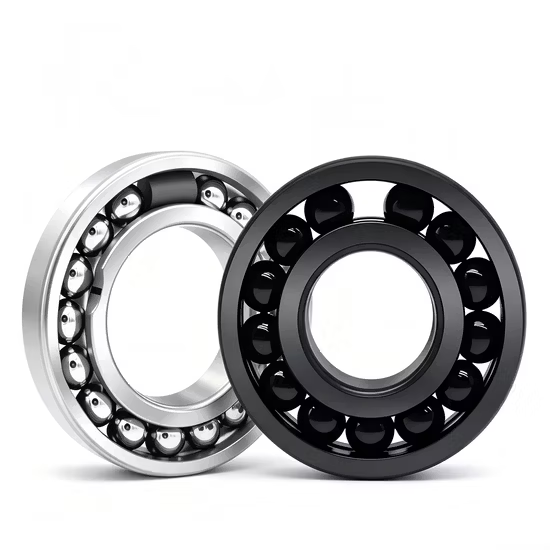
Selecting the right material variant is the first critical step in preventing premature failure. Depending on the exact thermal profile and load characteristics of your gas turbine or power generation equipment, these components are available in high-temperature alloy, ceramic, or specialized stainless steel variants. Each option offers distinct advantages regarding oxidation resistance and structural stability at elevated temperatures. A qualified high temperature alloy bearing supplier will evaluate your specific thermal gradients to recommend the optimal metallurgical match, ensuring the cage and rolling elements maintain their geometric integrity under continuous thermal stress.
Navigating Thermal Gradients and Lubrication Breakdown
Gas turbine environments subject rotating elements to severe combined loads and intense thermal gradients that rapidly degrade conventional lubricants. At elevated temperatures, standard grease carbonizes, leaving the rolling elements unprotected against severe friction and accelerated wear. Proper selection requires evaluating the operating temperature against the thermal limits of both the base material and the chosen lubrication method, whether that involves specialized high-temperature solid lubricants or continuous oil mist systems [NEED_CITE: lubrication failure mechanisms in high-temperature rotating equipment]. Furthermore, the thermal expansion differential between the shaft and housing must be calculated precisely to select the correct internal clearance, preventing the catastrophic seizure often seen when standard clearance classes are mistakenly installed in high-heat zones.
Decoding Metallurgical Stability and Clearance Selection
The core challenge in high-heat applications is maintaining the precise internal geometry as the entire assembly expands. Unlike standard applications where clearance selection primarily accounts for press-fit interference, extreme heat environments demand specialized clearance classes to accommodate massive thermal growth. The material options available—ranging from specialized high-temperature alloys to advanced ceramics—are chosen specifically for their ability to resist oxidation and retain hardness beyond the thermal limit of standard bearing steel. Proper specification also involves matching the cage material to the operating speed and temperature, as polymer cages will melt and standard brass cages may lose tensile strength, making specialized metallic or coated cages essential for maintaining rolling element separation.
The Hidden Costs of Thermal Seizure and Downtime
Installing a component that lacks the proper thermal stability or correct internal clearance inevitably leads to unplanned downtime and severe secondary damage. When thermal expansion consumes the internal clearance, the resulting friction generates even more heat, creating a destructive feedback loop that ends in catastrophic seizure. According to failure analysis frameworks like ISO 15243, this smearing and adhesive wear not only destroys the bearing but often scores the expensive turbine shaft and ruins the housing [NEED_CITE: bearing damage analysis per ISO 15243]. The financial impact extends far beyond the replacement part, encompassing lost generation revenue, emergency crane mobilization, and extensive machinery realignment.
Securing Authenticity in Critical Power Generation Spares
The market is flooded with counterfeit components featuring soft inner rings that pass casual visual inspections but fail rapidly under extreme thermal loads. We mitigate this risk by providing full batch and lot traceability for every high temperature alloy bearing we supply, linking directly to the manufacturer’s production facilities. Our cross-reference alignment goes beyond matching basic dimensions; we verify that the internal design, cage material, and clearance class perfectly match your extreme thermal application. By supplying components with verifiable material test reports, we ensure that the metallurgical properties claimed on the datasheet are exactly what gets installed in your gas turbine.
Documentation & Authenticity
- Certificate of Conformity confirming the specific high-temperature alloy grade and heat treatment batch.
- Original manufacturer batch and lot traceability linking directly to the production furnace records.
- Official app QR verification allowing on-site engineers to instantly authenticate the component before installation.
- Material test reports verifying oxidation resistance and hardness retention at elevated temperatures.
- Dimensional and running accuracy inspection reports confirming internal clearance tolerances prior to dispatch.
Storage, Handling & Mounting Protocols
- Store in original climate-controlled packaging to prevent condensation from compromising the specialized high-temperature surface treatments.
- Use clean thermal gloves during handling to prevent skin oils from initiating localized oxidation on the alloy raceways.
- Verify the specific high-temperature clearance class before mounting to ensure it matches the calculated thermal expansion profile.
- Apply only manufacturer-approved solid lubricants or high-heat pastes, as standard greases will carbonize and cause immediate seizure.
- Avoid using standard carbon steel tools on ceramic rolling element variants to prevent cross-contamination and surface micro-fractures.
Preparing Your Equipment Parameters for Technical Review
To ensure the selected component perfectly matches your gas turbine or power generation equipment, our engineering team requires specific operational data. Please provide the exact equipment model, available installation space, and the detailed load and speed profiles experienced at the mounting location. Additionally, specifying the peak operating temperature and the presence of any corrosive combustion byproducts allows us to determine the most appropriate material variant and internal clearance class for your application.
Frequently Asked Questions
Q: How do I determine the exact bearing designation for my gas turbine application?
A: Determining the correct designation requires a detailed analysis of your equipment’s operational parameters. You must provide the specific radial and axial loads, rotational speeds, peak operating temperatures, and shaft/housing dimensions. Our engineering team uses this data to calculate the required internal clearance and select the appropriate high-temperature material variant, ensuring the final specification perfectly matches the extreme thermal environment of your power generation equipment.
Q: What are the most common failure modes in high-temperature gas turbine applications?
A: The most frequent failure modes include thermal seizure due to insufficient internal clearance, cage degradation from exceeding material thermal limits, and lubricant carbonization leading to severe adhesive wear. Additionally, oxidation and surface scaling can occur if the base material lacks adequate high-temperature stability. Proper material selection and precise clearance calculations are essential to mitigate these destructive failure mechanisms and ensure reliable continuous operation.
Q: How do high-temperature alloys compare to standard bearing steel or ceramics?
A: High-temperature alloys offer superior structural stability and oxidation resistance at elevated temperatures compared to standard bearing steel, which loses hardness and dimensional accuracy under extreme heat. While ceramic variants provide excellent thermal stability and electrical insulation, they are more sensitive to shock loads and require careful handling. The optimal choice depends on balancing the specific thermal profile, load characteristics, and operational environment of your industrial equipment.
Q: What are the maintenance and lubrication requirements for extreme heat environments?
A: Standard lubricants rapidly degrade and carbonize in extreme heat, necessitating the use of specialized high-temperature solid lubricants, dry films, or continuous oil mist systems. Maintenance cycles must be adjusted to monitor for lubricant depletion, cage wear, and changes in operational vibration. Regular thermal imaging and vibration analysis are highly recommended to detect early signs of thermal expansion issues or lubrication breakdown before catastrophic failure occurs.