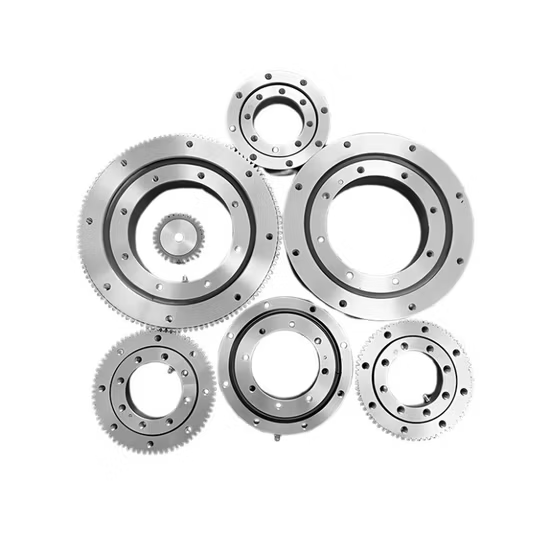
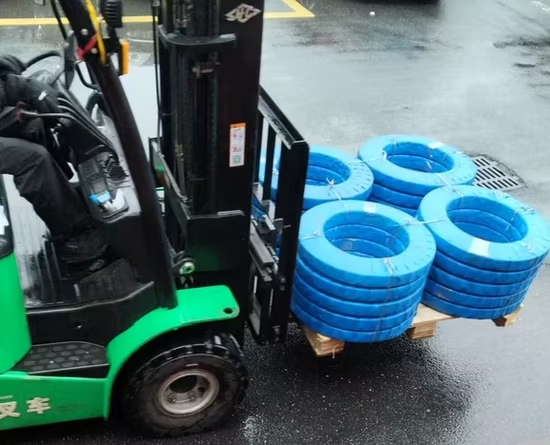
Unified Heavy-Duty Sourcing — Consolidate your rotating equipment procurement by integrating customized large-diameter rings with standard international brand bearings in a single shipment, eliminating multi-vendor coordination.
Technical Specifications
| Parameter |
Value |
| Product Type |
Slewing Bearing |
| Material Options |
Bearing Steel (customizable alloy variants available) |
| Main Configurations |
Single-Row Ball, Crossed Roller, Three-Row Roller |
| Key Structural Components |
Inner/Outer Ring, Rolling Elements, Sealing Strip, Spacer/Cage |
| Core Operational Features |
Large Size, Low Speed, High Load Capacity |
| Dimensional Specification |
Customized to equipment interface |
| Origin |
China |
Application Suitability
| Industry |
Typical Applications |
| Material Handling & Lifting |
Crane slewing mechanisms, stacker-reclaimer rotation joints |
| Earthmoving & Mining |
Excavator swing circles, continuous miner cutting heads |
| Renewable Energy |
Wind turbine pitch and yaw drive systems |
| Heavy Industrial Machinery |
Large-scale rotating platforms, bucket wheel excavators |
Why Slew Ring Failures Often Start at the Drawing Board
Specifying large-diameter rotation components requires more than matching basic envelope dimensions. An industrial slewing bearing supplier must evaluate the complex interplay of moment loads, axial forces, and structural deflection to prevent catastrophic ring deformation.
When procurement teams rely on superficial cross-referencing, they frequently overlook critical internal geometry differences. A single-row ball configuration mistakenly substituted for a crossed roller design under high tilting moment conditions will experience severe edge loading. This localized stress accelerates raceway spalling and compromises the sealing strip integrity, allowing abrasive mine dust to infiltrate the rolling elements. Such misalignments between the mechanical interface and the actual load profile routinely trigger unplanned downtime long before the steel reaches its theoretical fatigue limit [NEED_CITE: rolling bearing failure mode classification per ISO 15243].

Matching Structural Geometry to Rotational Demands
Selecting the correct internal architecture dictates the operational lifespan of heavy machinery. Single-row four-point contact ball designs excel in applications dominated by axial loads and moderate moments, offering lower friction for continuous yaw systems. Conversely, crossed roller arrangements provide superior rigidity and high moment capacity, making them indispensable for excavator swing circles where shock loads are constant. For extreme radial and axial combinations, three-row roller configurations distribute forces across dedicated raceways. As an experienced industrial slewing bearing supplier, we review your specific load vectors to ensure the selected geometry prevents raceway overstress.
Navigating the Harsh Realities of Low-Speed, High-Load Environments
Heavy-duty rotating platforms operate under severe mechanical and environmental stress. The combination of low rotational speeds and immense static loads prevents the formation of a full elastohydrodynamic lubrication film, increasing the risk of boundary lubrication and surface wear. Furthermore, equipment deployed in mining or cement production faces constant exposure to abrasive particulates. If the sealing strip design lacks adequate lip contact pressure or labyrinth complexity, contaminant ingress rapidly degrades the grease and scores the raceways. Thermal fluctuations also dictate the internal clearance requirements; insufficient clearance compensation during assembly can lead to preload spikes and premature cage failure when the structure expands under operational heat [NEED_CITE: impact of low-speed boundary lubrication on large-diameter bearings].
Decoding Material and Configuration Variables
Because these components are inherently nonstandard, material selection and heat treatment profiles must align with the specific operating environment. While standard bearing steel provides the necessary core hardness and fatigue resistance for most general-purpose applications, alternative material options such as specialized alloy steels or corrosion-resistant variants are available for marine or highly caustic environments. The internal spacer or cage design also plays a pivotal role; segmented spacers reduce friction and accommodate misalignment better than full cages in heavily loaded zones. Ultimately, the dimensional specifications and gear teeth profiles—whether internal or external—must be customized to mesh perfectly with the drive pinion, ensuring smooth torque transmission without localized pitting.
The Hidden Toll of Dimensional and Structural Compromises
Accepting slight deviations in mounting hole patterns or raceway hardness to expedite delivery often results in severe long-term penalties. Improperly matched gear profiles cause uneven load distribution, leading to rapid tooth wear and catastrophic drive failure. Furthermore, inadequate structural rigidity in the supporting frame transfers excessive deflection to the bearing rings, causing binding and accelerated fatigue. These issues manifest as chronic maintenance interventions, voided equipment warranties, and ultimately, the complete replacement of the rotation assembly, driving operational costs far beyond the initial procurement savings [NEED_CITE: structural deflection effects on large-diameter bearing life].
Securing Traceability and Engineering Accuracy in Heavy Components
Sourcing large-scale rotation components demands rigorous verification beyond standard catalog checks. First, we ensure complete batch and lot traceability to the manufacturer’s production facilities, providing transparency into the forging and heat treatment origins. Second, our cross-reference alignment verifies internal load paths, sealing specifications, and gear module parameters, not just outer dimensions. Third, we mandate dimensional and running accuracy inspection reports for every customized unit before dispatch. Finally, our application-based selection review scrutinizes your equipment’s specific moment and axial load profiles to prevent the costly mismatch of internal geometries.
Documentation & Authenticity
- Certificate of Conformity validating the specific bearing steel grade and heat treatment protocols.
- Batch and lot traceability linking the forged rings to the manufacturer’s original production records.
- Dimensional and running accuracy inspection reports confirming gear profile and raceway tolerances.
- Material test reports verifying the mechanical properties of the customized structural components.
- Country-of-origin documentation ensuring compliance with international project sourcing mandates.
Storage, Handling & Mounting Protocols
- Keep the customized sealing strips protected from UV exposure and ozone during prolonged outdoor yard storage.
- Use non-marking, heavy-duty nylon slings for lifting to prevent edge damage to the precision-machined outer rings.
- Align the factory-applied match marks on the inner and outer rings precisely before tightening mounting bolts.
- Apply the specified high-viscosity extreme-pressure grease through all designated fittings until purged from the seals.
- Verify the structural flatness of the supporting frame to prevent induced distortion in the large-diameter rings.
Engineering Support for Nonstandard Rotation Interfaces
To ensure the selected configuration withstands your specific operational demands, please provide the exact equipment model, available installation envelope, and detailed load spectra including maximum axial, radial, and tilting moment forces. Supplying information regarding the operating environment, such as exposure to abrasive dust or extreme temperature variations, allows our engineering team to determine the optimal material options and sealing arrangements. In return, you receive a comprehensive technical proposal detailing the customized dimensional specifications and expected service life calculations.
Frequently Asked Questions
Q: How do we determine the exact slewing bearing configuration for a new heavy-duty design?
A: Determining the correct configuration requires calculating the maximum static and dynamic loads, including axial, radial, and tilting moments. By providing these load vectors alongside the required rotational speed and mounting space constraints, our engineering team can recommend whether a single-row, crossed roller, or three-row design offers the optimal balance of rigidity, load capacity, and friction for your specific application.
Q: What are the most common failure modes in heavy-duty slewing applications and how are they prevented?
A: Premature failures typically stem from raceway spalling due to edge loading, gear tooth pitting from misalignment, or seal failure allowing abrasive ingress. Prevention relies on selecting a configuration with adequate static load safety margins, ensuring the supporting structure is sufficiently rigid to prevent ring distortion, and specifying robust sealing strips matched to the environmental contamination levels of the operational site.
Q: How do material and heat treatment considerations affect performance in harsh mining environments?
A: In harsh environments, standard bearing steel must undergo precise induction hardening to achieve the necessary raceway surface hardness while maintaining a tough, ductile core to absorb shock loads. For highly corrosive or abrasive conditions, alternative material options and specialized surface treatments can be specified to enhance wear resistance and prevent micro-pitting that accelerates fatigue under boundary lubrication conditions.
Q: What information is needed to establish lead times for customized nonstandard dimensions?
A: Lead times for nonstandard dimensions depend on the complexity of the forging, the required gear cutting, and the specific heat treatment cycles. To provide an accurate schedule, we need the finalized dimensional drawings, the selected material grade, and the required inspection protocols. Once these parameters are locked, we can confirm the manufacturing timeline and minimum order quantities for the customized batch.
Q: What are the critical maintenance intervals for lubrication and sealing strip replacement?
A: Maintenance intervals depend heavily on the operational duty cycle and environmental contamination. Generally, heavy-duty applications require frequent regreasing to purge contaminants from the raceways and maintain the boundary lubrication film. Sealing strips should be inspected regularly for wear or extrusion; if abrasive material is detected in the purged grease, immediate seal replacement is necessary to prevent catastrophic internal scoring.