Verified Thermal Traceability — Every shipment includes scannable QR codes linking directly to the manufacturer’s official verification app, confirming the exact alloy composition and heat treatment batch for extreme environments.
Technical Specifications
| Parameter |
Value |
| Product Type |
High Temperature Bearing |
| Material Options |
Available in stainless steel or alloy steel variants |
| Operating Temperature Range |
Up to 800℃ |
| Thermal Feature |
High thermal stability under continuous radiant heat |
| Customization |
OEM/ODM supported for non-standard furnace dimensions |
| Target Application |
Heat treatment furnaces and industrial thermal equipment |
Application Suitability
| Industry |
Typical Applications |
| Steel and Metallurgy |
Continuous annealing line rollers, quenching tank conveyors, retort basket supports |
| General MRO |
Industrial batch furnace hearth mechanisms, carburizing tray transfer systems |
Thermal Expansion Traps: Why Your High Temperature Heat Treatment Furnace Bearing Supplier Must Verify Internal Clearances
Standard clearance bearings lock solid when exposed to radiant furnace heat, turning minor thermal growth into catastrophic mechanical seizures.
I once tore down a failed batch furnace roller at a trade show in Hanover; the inner ring had expanded so severely under continuous heat that the standard clearance vanished completely, snapping the cage and scattering debris across the raceway. Sourcing from a qualified high temperature heat treatment furnace bearing supplier prevents these unplanned shutdowns by matching the internal geometry to the actual operating thermal gradient [NEED_CITE: rolling bearing failure mode classification per ISO 15243]. When procurement teams overlook the clearance shift caused by extreme temperature differentials between the shaft and the housing, the resulting friction destroys the lubricant and welds the rolling elements to the rings.

Matching Alloy Options to Specific Furnace Atmospheres
Selecting the right material is critical when specifying a high temperature heat treatment furnace bearing supplier for your facility. Components are available in stainless steel or alloy steel variants, depending on whether the primary threat is corrosive quenching gases or pure thermal degradation. Stainless options resist the oxidizing atmospheres common in continuous annealing lines, while specialized alloy steels maintain structural rigidity in heavily loaded hearth mechanisms. Our engineering review ensures the selected material option aligns perfectly with your specific furnace environment and maintenance schedule.
Navigating Extreme Heat and Heavy Roller Loads
Furnace rollers and transfer mechanisms endure combined radial loads from heavy metal trays while simultaneously absorbing axial thrust from thermal warping of the conveyor structure. The intense radiant heat drastically reduces the viscosity of standard lubricants, demanding specialized high-temperature pastes or solid lubricants that won’t carbonize and block the rolling paths [NEED_CITE: lubrication failure mechanisms at elevated temperatures]. Furthermore, the massive temperature differential between the hot shaft and the relatively cooler outer housing requires careful consideration of thermal expansion rates to prevent the bearing from binding inside the housing bore during peak operating cycles.
Decoding Material and Clearance Selection for Thermal Stability
In application-oriented thermal equipment, the internal clearance and material choice dictate survival. While standard bearings rely on tight internal gaps for precision, high-temperature applications demand wider internal clearances to accommodate the disproportionate expansion of the inner ring when heated. The choice between stainless steel and alloy steel variants depends entirely on the presence of corrosive quenching vapors or the need for maximum load capacity at elevated temperatures. Proper selection ensures the bearing maintains its operational geometry and prevents the cage from dragging against the expanding raceways.
The Hidden Costs of Ignoring Thermal Expansion Dynamics
Installing a standard industrial bearing in a heat treatment furnace inevitably leads to premature failure and catastrophic damage to the surrounding conveyor infrastructure. When the internal clearance closes due to uncalculated thermal growth, the resulting friction generates secondary heat, accelerating cage wear and ultimately causing the roller to seize mid-cycle. According to failure analysis frameworks like ISO 15243, this type of thermal seizure often voids equipment warranties and forces complete line stoppages to extract the fused components [NEED_CITE: ISO 15243 thermal seizure damage patterns]. The cost of replacing a destroyed furnace roller far exceeds the initial investment in properly specified thermal components.
Why Procurement Engineers Trust Our Technical Validation
We eliminate the guesswork in high-temperature sourcing by validating the exact internal clearance required for your specific furnace temperature profile. Instead of just matching a base part number, we review the thermal expansion characteristics to ensure the selected variant won’t bind when the shaft reaches peak operating heat. Our batch traceability guarantees that the alloy composition matches the manufacturer’s original material test reports, preventing the installation of counterfeit rings that soften and deform under radiant heat. This technical depth ensures your maintenance team receives components engineered for survival, not just dimensional equivalence.
Documentation & Authenticity
- Material test reports confirming the exact alloy composition for high-temperature structural integrity.
- Dimensional and running accuracy inspection reports verifying internal clearance before thermal expansion.
- Batch and lot traceability linking each unit to the manufacturer’s original heat treatment records.
- Country-of-origin documentation ensuring compliance with international metallurgy standards.
- Scannable QR verification via official brand apps to confirm authenticity upon delivery.
Storage, Handling & Mounting Protocols
- Store alloy steel variants in climate-controlled environments to prevent surface oxidation before furnace installation.
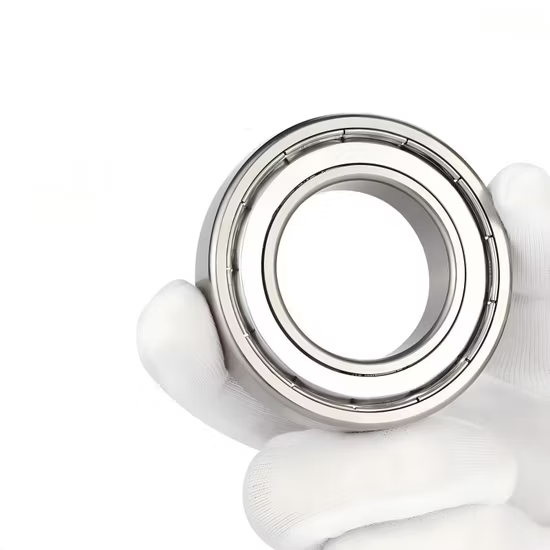
- Use clean thermal gloves when handling stainless steel options to avoid carbon steel cross-contamination from bare hands.
- Apply induction heating strictly within specified limits to preserve the factory-set internal clearance during mounting.
- Ensure high-temperature solid lubricants are applied evenly to prevent dry-start friction in radiant heat zones.
- Verify the housing bore tolerances to accommodate the differential expansion rates between the shaft and the furnace structure.
Preparing Your Equipment Parameters for Technical Review
To ensure precise selection for your thermal equipment, please provide the exact furnace operating temperature, the maximum radial and axial loads on the rollers, and the specific atmospheric conditions inside the chamber. Sharing the original equipment manufacturer’s drawings or the physical dimensions of the housing and shaft allows our engineering team to calculate the required internal clearance and recommend the optimal material variant. This data-driven approach guarantees the recommended solution will withstand your specific thermal and mechanical demands.
Frequently Asked Questions
Q: How do I determine the exact bearing designation for my furnace rollers?
A: Provide the operating temperature, shaft and housing dimensions, and the specific load characteristics of your furnace mechanism. Our engineering team uses these parameters to calculate the necessary internal clearance and select the appropriate material variant, ensuring the final designation perfectly matches your thermal expansion requirements without risking mid-cycle seizure.
Q: Should I choose stainless steel or alloy steel for my heat treatment furnace?
A: The choice depends on the furnace atmosphere and load requirements. Stainless steel variants are ideal for environments with corrosive quenching gases or oxidizing atmospheres, while alloy steel options offer superior load-bearing capacity in purely high-temperature, dry environments. We evaluate your specific process conditions to recommend the most durable material option.
Q: What causes standard bearings to fail so quickly inside heat treatment furnaces?
A: Standard bearings typically fail due to thermal expansion closing the internal clearance, causing the rolling elements to bind and the cage to fracture. Without the wider internal gaps designed specifically for high-temperature gradients, the disproportionate expansion of the inner ring generates extreme friction, leading to rapid lubricant degradation and catastrophic mechanical seizure.
Q: How can I source replacements if the original OEM furnace parts are discontinued?
A: Share the physical dimensions, operating temperatures, and load data from your equipment. We perform a comprehensive cross-reference review that accounts for thermal expansion and material compatibility, not just basic outer dimensions. This allows us to identify an exact functional equivalent that maintains the required internal clearance and structural stability for your specific application.