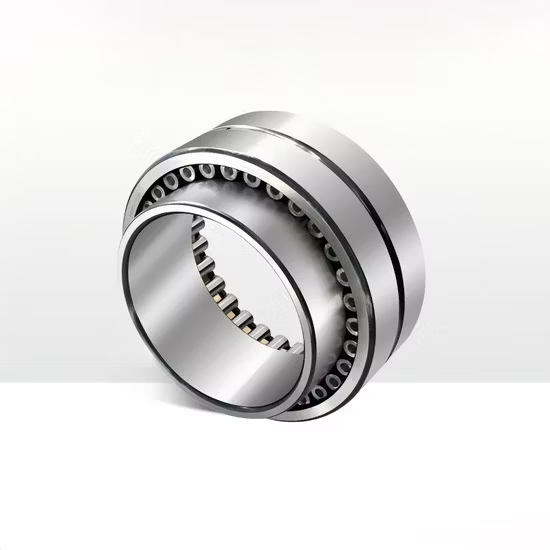
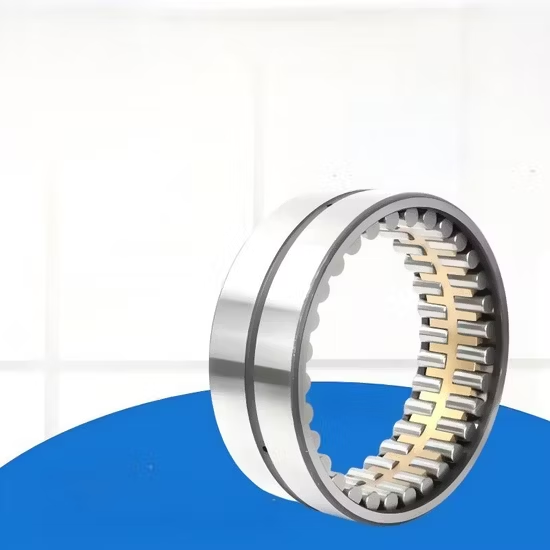
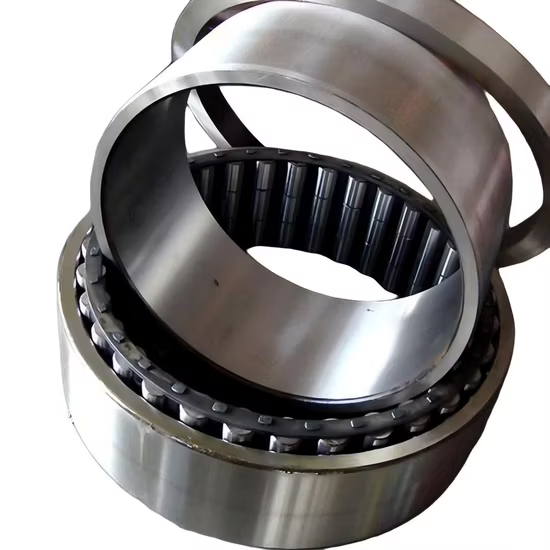
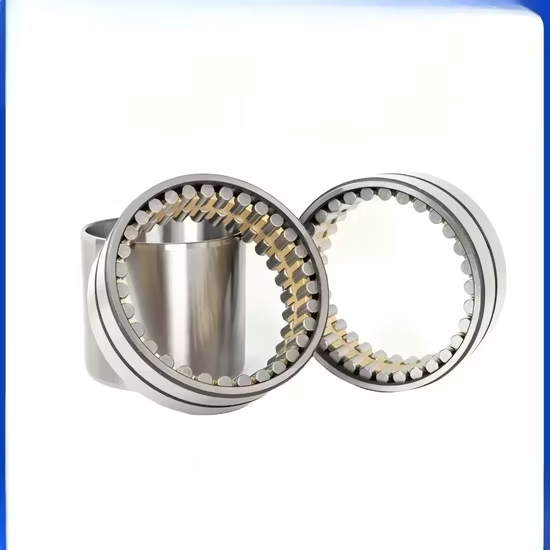
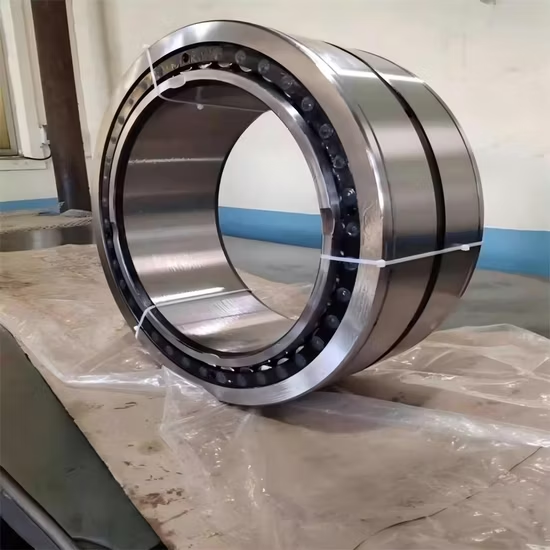
Batch Traceability Assurance — Every sealed sintering machine wheel bearing shipment includes verifiable manufacturer lot codes and official app QR validation to guarantee material authenticity.
Technical Specifications
| Parameter |
Value |
| Product Type |
Sealed Tapered Roller Bearing |
| Material Options |
Available in high-purity bearing steel or specialized alloy variants |
| Seal Configuration |
Heavy-duty sealed type for extreme contamination exclusion |
| Application Focus |
Sintering machine wheels and heavy-duty metallurgical transport |
| Certification |
ISO 9001 compliant manufacturing with full batch traceability |
| Customization |
Application-specific internal geometry and clearance matching |
Application Suitability
| Industry |
Typical Applications |
| Steel and Metallurgy |
Sintering machine pallet wheels, continuous casting transport rolls |
| Mining and Crushing |
Heavy-duty industrial transport wheels, rotary breaker support |
| Material Handling |
High-temperature conveyor guide rollers, bulk material transfer cars |
Why Sintering Plant Wheels Fail Before the Steel Does
Dimensional matching without application-specific sealing and clearance review leads to catastrophic thermal binding.
In metallurgical environments, a frequent cause of premature wheel seizure is not the basic envelope dimensions, but the failure of internal seals to exclude abrasive scale and sintering dust. When standard seals degrade under continuous radiant heat, contaminants mix with the lubricant, forming a solid abrasive paste that destroys the raceways. Relying solely on physical dimensions while ignoring the thermal expansion requirements of the internal geometry results in unplanned downtime and severe structural damage to the wheel housings [NEED_CITE: rolling bearing failure mode classification per ISO 15243].

Matching the Sealed Sintering Machine Wheel Bearing Supplier to Plant Realities
Selecting the correct sealed sintering machine wheel bearing supplier requires looking beyond basic catalog numbers. In sintering plants, the ambient thermal load and heavy shock loads demand a component engineered for extreme survival. Our technical review process evaluates the specific operating temperature and dust concentration of your transport line, ensuring the sealing architecture and internal geometry are matched to the actual plant environment rather than generic industrial assumptions.
The Thermal and Contamination Challenges of Sintering Transport
Sintering machine wheels operate under a brutal combination of heavy radial loads, low rotational speeds, and intense radiant heat from the material bed. These conditions cause significant thermal expansion within the housing and the bearing components. If the internal clearance is not specified to accommodate this expansion, the rolling elements will bind as temperatures rise. Furthermore, the pervasive presence of fine, abrasive iron oxide dust requires sealing solutions that maintain lip contact and structural integrity without generating excessive friction heat [NEED_CITE: bearing clearance selection for elevated temperature applications].
Material Options and Application-Specific Engineering
The internal architecture and material selection dictate the survival of the bearing in metallurgical transport. While high-purity bearing steel provides the necessary core hardness and structural integrity to withstand heavy shock loads, specialized alloy variants are available for zones with extreme thermal exposure. The sealing design is critical; robust contact seals prevent abrasive ingress but must be balanced against friction, whereas specialized high-temperature grease formulations are required to resist drying out and caking inside the cavity. Selecting the right combination of material and seal type ensures the component survives the specific thermal profile of the sintering line.
The Hidden Costs of Ignoring Application Parameters
Substituting a standard industrial bearing into a sintering machine wheel application without verifying the internal clearance and seal effectiveness inevitably leads to premature failure. According to failure analysis frameworks like ISO 281 and ISO 15243, contamination and thermal binding are primary drivers of reduced L10 life in heavy machinery. The resulting unplanned downtime, emergency maintenance labor, and potential damage to the wheel axle and housing far exceed the initial procurement savings of an incorrectly specified component [NEED_CITE: impact of contamination on bearing fatigue life per ISO 281].
Why Procurement Engineers Trust Our Technical Review
Our approach eliminates the cross-reference errors that plague mixed-brand procurement. We verify that the internal clearance and sealing structures match your specific sintering machine requirements, not just the outer dimensions. Every unit is backed by authorized distribution channels, ensuring batch traceability and authenticity. We provide comprehensive application-based selection reviews, analyzing your load, speed, and temperature parameters to prevent field failures. Furthermore, our cross-brand interchange expertise guarantees that replacement units maintain the exact performance characteristics required by the OEM equipment.
Documentation & Authenticity
- Certificate of Conformity validating the specific metallurgical transport application parameters.
- Manufacturer batch and lot traceability linked directly to the production facility records.
- Official brand app QR verification for immediate authenticity checks on the shop floor.
- Material test reports confirming the chemical composition of the bearing steel or alloy variants.
- Dimensional and running accuracy inspection reports verifying tolerance adherence before dispatch.
Storage, Handling & Mounting Protocols
- Retain original factory packaging until mounting to protect the specialized high-temperature grease from ambient moisture.
- Store in a climate-controlled environment to prevent condensation from compromising the heavy-duty sealing lips.
- Use clean, lint-free gloves during handling to avoid transferring skin oils onto the precision-machined outer surfaces.
- Employ induction heating for mounting, strictly avoiding open flames that could destroy the internal seal elastomers.
- Verify housing dimensions and shaft tolerances prior to installation to prevent altering the critical internal clearance.
Engineering Support and Inquiry Requirements
To ensure precise technical matching for your sintering machine wheels, please provide the specific equipment OEM model, the exact installation space envelope, and the operational parameters including radial load, rotational speed, and maximum ambient temperature. Detailing the environmental exposure, such as dust concentration and thermal radiation levels, allows our engineering team to determine the optimal internal clearance, seal configuration, and material variant for your application.
Frequently Asked Questions
Q: How do we determine the exact internal roller type when OEM manuals are missing?
A: When original documentation is unavailable, our engineering team conducts a technical cross-reference based on the physical envelope dimensions, housing design, and specific load characteristics of the sintering machine. By analyzing the application parameters and existing failure modes, we can identify whether a tapered or cylindrical internal geometry is required to safely handle the combined radial and axial forces present in your transport wheels.
Q: What are the most common seal failure modes in high-temperature sintering environments?
A: In sintering applications, standard seals often harden and crack due to continuous radiant heat, allowing abrasive iron oxide dust to infiltrate the bearing cavity. This cont* paste that accelerates raceway wear and leads to catastrophic seizure. Selecting seals engineered for high-thermal stability and pairing them with temperature-resistant grease is essential to prevent these specific metallurgical failure modes.
Q: How should internal clearance be selected to accommodate thermal expansion in these applications?
A: Sintering machine wheels experience significant temperature gradients that cause the inner and outer rings to expand at different rates. If standard clearance is used, the thermal expansion will eliminate the internal play, causing the rolling elements to bind and generate excessive friction heat. We calculate the required operational clearance based on your specific temperature profiles to ensure the bearing maintains optimal internal geometry under full thermal load.
Q: What material certifications should accompany heavy-duty bearings for metallurgical use?
A: Bearings deployed in critical metallurgical transport must be accompanied by comprehensive documentation, including a Certificate of Conformity, material test reports verifying the chemical composition of the steel or alloy, and dimensional inspection reports. Furthermore, full batch traceability and QR verification are necessary to guarantee that the components are genuine and manufactured to the strict quality standards required for heavy-load, high-temperature environments.
Q: How do we establish a predictive maintenance cycle for sealed wheel bearings?
A: Since sealed bearings in sintering machines are typically non-relubricatable and operate in highly contaminated zones, maintenance relies on condition monitoring rather than scheduled greasing. We recommend establishing a predictive cycle using thermal imaging and vibration analysis to detect early signs of seal degradation or internal wear. This allows for planned replacement during scheduled plant shutdowns, avoiding the catastrophic failures associated with run-to-breakdown strategies.