Multi-Brand Sourcing Unified — Procure mixed-brand high-temperature replacements for stenter lines through a single authorized channel, eliminating multi-vendor coordination delays.
Technical Specifications
| Parameter |
Value |
| Product Type |
High Temperature Textile Bearing |
| Bearing Type |
High Temperature Bearing |
| Application |
Textile machinery, Stenter machines, Drying cylinders |
| Material Options |
High-temperature alloy steel, ceramic rolling elements, specialized coatings |
| Cage Material Options |
High-temperature resistant alloys, specialized polymers |
| Clearance Class Options |
C3, C4, or custom thermal expansion clearances |
| Lubrication Compatibility |
High-temperature greases, solid lubricants |
| Certification |
ISO 9001 compliant manufacturing processes |
Application Suitability
| Industry |
Typical Applications |
| Textile Manufacturing |
Stenter machine chain drives, tenter frame roller guides |
| Textile Processing |
Drying cylinder support journals, hot air exhaust fans |
| Industrial Finishing |
Heat setting oven conveyors, continuous bleaching ranges |
Thermal Binding in Stenter Machines: Why Standard Clearances Fail
Standard clearances vanish when ambient heat exceeds the thermal expansion threshold of the bearing steel.
When a drying cylinder operates continuously, the inner ring expands faster than the housing. If a standard CN clearance is installed instead of a thermally compensated C3 or C4 variant, the rolling elements lose their internal play. I once investigated a catastrophic stenter machine failure in Dubai where a standard clearance bearing seized completely inside a drying cylinder, generating enough friction to melt the cage and produce visible smoke. Selecting the correct high temperature textile bearing supplier ensures that thermal expansion rates are calculated against the specific operating heat, preventing unplanned line stoppages and secondary damage to the machine housing [NEED_CITE: rolling bearing failure mode classification per ISO 15243].

Matching Material Options to Extreme Textile Heat
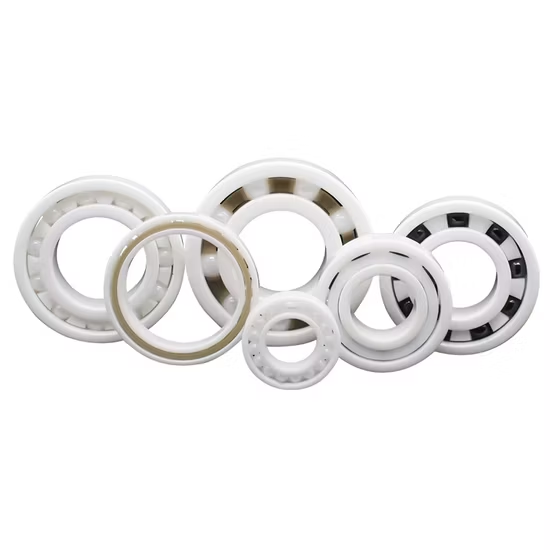
Sourcing the right component requires aligning material options with the specific thermal profile of the equipment. As a specialized high temperature textile bearing supplier, we evaluate whether high-temperature alloy steel, ceramic rolling elements, or specialized surface coatings best suit the drying cylinder’s operating environment. Ceramic variants offer considerably less thermal expansion and lower density, reducing centrifugal forces at elevated speeds, while specialized coatings protect against micro-p*at. This application-based selection prevents premature degradation and ensures the internal geometry remains stable throughout the machine’s duty cycle.
Drying Cylinder Load Profiles and Lubrication Breakdown
The support journals of drying cylinders endure combined radial loads and moderate axial thrust from the heavy, rotating drums. At elevated temperatures, standard lubricants oxidize rapidly, leaving the raceways unprotected. High-temperature compatible greases or solid lubricants are essential to maintain a protective film between the rolling elements and the cage. Furthermore, the choice of cage material—whether high-temperature resistant alloys or specialized polymers—dictates how well the bearing handles the vibrational shocks inherent in continuous textile processing lines without suffering from cage pocket wear [NEED_CITE: lubrication failure mechanisms in elevated temperature environments per ISO 281].
Decoding Thermal Expansion and Internal Geometry
In high-heat applications, the internal geometry must accommodate significant dimensional shifts. Selecting a C3 or C4 clearance class provides the necessary internal play to absorb the differential expansion between the shaft and the housing. The cage design is equally critical; a machined high-temperature alloy cage maintains its structural integrity and guides the rolling elements precisely, even when thermal gradients cause localized distortions. Proper cross-referencing must verify not just the base bore and outside diameter, but also the exact clearance suffix and cage material designation to ensure the component survives the specific thermal cycle of the stenter machine.
The Hidden Costs of Ignoring Thermal Compensation
Installing a bearing without verifying its thermal compensation parameters leads directly to catastrophic internal binding. According to failure analysis frameworks like ISO 15243, thermal seizure causes severe smearing on the raceways and immediate cage disintegration. This results in unplanned downtime, the destruction of adjacent sealing components, and potential warping of the drying cylinder shaft. The financial impact extends far beyond the replacement part, encompassing lost production shifts, emergency maintenance labor, and the complete voidance of equipment warranties due to improper specification adherence [NEED_CITE: economic impact of unplanned downtime in continuous process manufacturing].
Why Procurement Verification Matters for Textile Spares
Mixed-brand requirements across a single textile plant often lead to cross-reference errors where the base number matches, but the critical high-temperature suffixes are overlooked. We prevent this by verifying the exact clearance, cage material, and thermal limits for every cross-referenced equivalent. Our authorized channel access guarantees batch traceability for every high-temperature variant, ensuring you receive genuine alloys rather than standard steel disguised with high-temperature labels. We provide application-based selection reviews that factor in your specific stenter machine load and speed parameters, eliminating the guesswork that leads to premature field failures.
Documentation & Authenticity
- Certificate of Conformity verifying the specific high-temperature alloy grade used in the rings and rolling elements.
- Batch and lot traceability linking the drying cylinder bearing directly to the manufacturer’s original heat treatment records.
- QR verification via official brand apps to confirm the authenticity of high-temperature suffixes and clearance classes.
- Material test reports validating the thermal stability and composition of specialized cage materials.
- Dimensional and running accuracy inspection reports confirming C3 or C4 clearance tolerances before shipment.
Storage, Handling & Mounting Protocols
- Store high-temperature variants in their original vapor-phase inhibitor packaging to prevent surface oxidation before installation in the stenter machine.
- Use clean, lint-free thermal gloves when handling ceramic rolling element options to prevent skin oils from degrading high-temperature performance.
- Apply induction heating strictly within the manufacturer’s specified thermal limits to avoid altering the specialized heat treatment of the inner ring.
- Ensure high-temperature compatible grease is applied immediately after unsealing to protect the raceways during the initial run-in phase.
- Verify the shaft and housing tolerances account for the specific thermal expansion coefficients of the selected material options.
Engineering Support for Exact Model Determination
To ensure the selected component perfectly matches your stenter machine or drying cylinder, please provide the specific equipment model, the exact installation space dimensions, and the operational parameters including maximum ambient heat, rotational speed, and load characteristics. Our engineering team will use this data to determine the precise model, required clearance class, and optimal material options, delivering a comprehensive technical review and cross-reference validation before quotation.
Frequently Asked Questions
Q: How do I determine the exact bearing model for my stenter machine?
A: Provide the OEM equipment number, installation dimensions, and operating parameters such as maximum heat and rotational speed. Our engineering team will analyze the thermal expansion requirements and load profiles to specify the exact model, clearance class, and material options needed for reliable operation.
Q: What are the common failure modes in textile drying cylinders?
A: The most frequent issue is thermal binding caused by installing standard CN clearance instead of C3 or C4 variants. As the shaft expands under extreme heat, the internal play vanishes, leading to excessive friction, cage disintegration, and eventual seizure of the rolling elements on the raceways.
Q: How do material options differ for high-heat textile applications?
A: High-temperature alloy steels offer excellent load capacity, while ceramic rolling elements provide considerably less thermal expansion and lower density. Specialized coatings can also be applied to prevent micro-pitting when lubrication films thin out, depending on the specific speed and load conditions of the machinery.
Q: Why is clearance selection critical for high-heat environments?
A: Heat causes the inner ring to expand faster than the outer housing. Selecting a C3 or C4 clearance provides the necessary internal gap to absorb this differential expansion. Without this thermal compensation, the bearing will bind internally, generating excessive friction and leading to rapid catastrophic failure.
Q: What maintenance is required for high-heat textile bearings?
A: Maintenance focuses on monitoring the condition of high-temperature lubricants, which degrade faster under extreme heat. Regular re-lubrication cycles using compatible high-heat greases are essential to maintain the protective film and prevent metal-to-metal contact within the raceways and cage pockets.