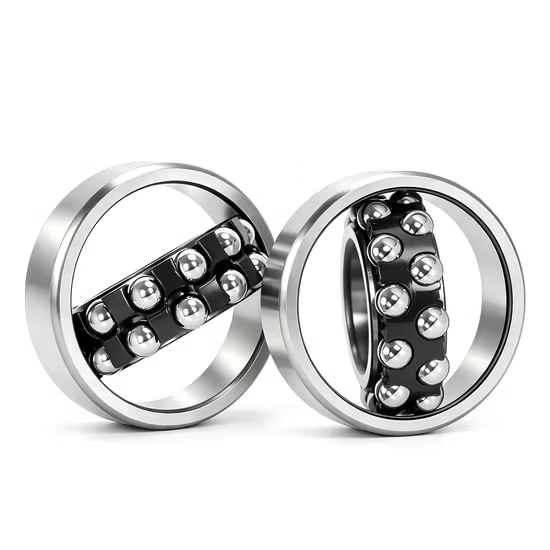
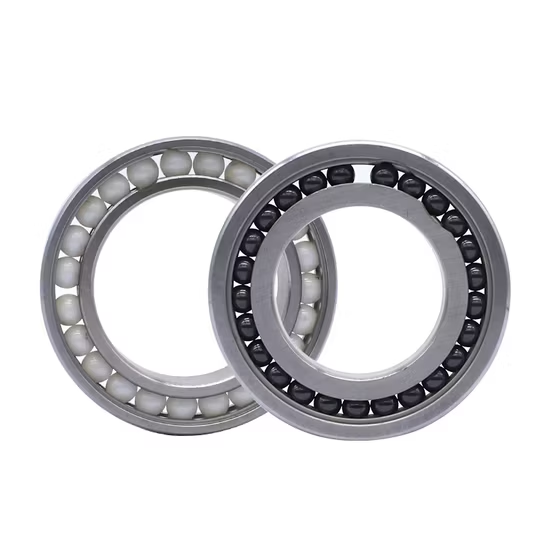
Cross-Reference Alignment Verified — We match base designations with exact clearance, solid lubricant formulation, and precision classes to prevent thermal binding in vacuum environments.
Technical Specifications
| Parameter |
Value |
| Product Type |
Ceramic Bearing |
| Material Options |
Ceramic rolling elements and rings |
| Lubrication |
Greaseless solid lubrication |
| Operating Temperature |
Up to 350°C continuous |
| Precision Class |
P4 / P5 |
| Vacuum Compatibility |
High vacuum compatible (low outgassing) |
| Key Features |
Corrosion resistant, antimagnetic, high speed capable |
| Certification |
RoHS, CE |
| Customization |
Available for non-standard envelopes |
Application Suitability
| Industry |
Typical Applications |
| Semiconductor Manufacturing |
Wafer transfer robot arm joints, vacuum chamber linear guides |
| Cleanroom Automation |
Articulated robot wrist assemblies, automated guided vehicle drive hubs |
| High-Temperature Processing |
Industrial oven conveyor rollers, heat treatment furnace mechanisms |
| Chemical Processing |
Corrosive fluid pump shafts, agitator support housings |
Why Sourcing From a Qualified High Temperature Greaseless Ceramic Bearing Supplier Prevents Wafer Contamination
Standard grease-lubricated bearings outgas and degrade in cleanroom vacuums, causing particulate contamination and catastrophic equipment downtime.
When standard lubricants break down under extreme heat or high-vacuum conditions, they release volatile compounds that coat sensitive optical sensors and ruin semiconductor wafers. I have seen precision modules seize entirely because conventional grease carbonized inside the raceway, turning into a solid abrasive mass. Selecting the right solid-lubricated alternative is not just about surviving the heat; it is about protecting the entire cleanroom ecosystem from invisible chemical pollution [NEED_CITE: outgassing contamination mechanisms in vacuum environments].

Matching Material Options to Cleanroom and Vacuum Demands
Finding a dependable high temperature greaseless ceramic bearing supplier means looking beyond basic dimension matching. Our engineering review ensures the selected ceramic variants and solid lubricant matrices align perfectly with your specific vacuum levels and thermal cycles, preventing the subtle material mismatches that lead to early degradation.
Thermal and Tribological Challenges in Semiconductor Environments
In high-vacuum semiconductor equipment, traditional oil or grease lubricants evaporate rapidly, leaving rolling elements completely dry and prone to severe adhesive wear. At elevated temperatures approaching 350°C, the thermal expansion differences between the shaft and housing can eliminate internal clearance, causing standard steel bearings to bind and fail. Solid lubrication eliminates the risk of volatilization while maintaining a consistent transfer film across the contact zones. Furthermore, the absence of liquid lubricants prevents the accumulation of airborne particulate matter, which is critical for maintaining ISO-class cleanroom integrity [NEED_CITE: rolling bearing failure mode classification per ISO 15243].
Evaluating Ceramic Variants and Precision Tolerances
Selecting the correct configuration involves evaluating available ceramic options against the specific chemical and magnetic environment of the equipment. Ceramic materials offer inherently antimagnetic properties and substantial resistance to corrosive processing chemicals, unlike standard bearing steel. Achieving P4 or P5 precision classes ensures the high-speed running accuracy required for delicate wafer handling, minimizing vibration that could misalign robotic end-effectors. The greaseless solid lubrication matrix is engineered to withstand continuous thermal cycling without breaking down, ensuring that the bearing maintains its geometric stability and operational smoothness throughout its service life.
The Hidden Costs of Incorrect Solid Lubrication Selection
Installing a bearing with an incompatible solid lubricant formulation often results in unplanned downtime and premature failure of the entire robotic module. If the thermal limits of the lubricant are exceeded, the transfer film degrades, leading to catastrophic damage to the ceramic raceways and subsequent warranty voidance. Misjudging the required precision class for high-speed vacuum applications introduces micro-vibrations that compromise manufacturing yields. These failures rarely occur immediately, making them difficult to trace back to the initial component selection error [NEED_CITE: ISO 281 bearing life calculation limitations in extreme environments].
Why Procurement Engineers Trust Our Technical Validation
We provide authorized distribution coverage that ensures every component is backed by full batch traceability, eliminating the risk of counterfeit parts with cloned markings. Our cross-reference expertise goes beyond matching base numbers; we verify that the internal clearance, solid lubricant type, and precision suffixes exactly match your equipment’s operational demands. When application parameters involve unusual thermal gradients or vacuum levels, our technical team conducts a thorough selection review to prevent field failures. We consolidate mixed-brand requirements into single shipments, reducing the administrative burden of coordinating multiple vendors for complex cleanroom builds.
Documentation & Authenticity
- Certificate of Conformity validating RoHS and CE compliance for cleanroom integration.
- Original manufacturer batch and lot traceability for every solid-lubricated unit shipped.
- Official app QR verification confirming the authenticity of the ceramic components.
- Material test reports verifying the exact solid lubricant formulation and ceramic purity.
- Running accuracy inspection reports confirming P4/P5 tolerances prior to dispatch.
- Country-of-origin documentation supporting international semiconductor supply chain audits.
Storage, Handling & Mounting Protocols
- Store ceramic units in original moisture-barrier packaging to protect the solid lubricant matrix from ambient humidity.
- Wear certified cleanroom gloves during handling to prevent skin oils from compromising the antimagnetic ceramic surfaces.
- Avoid using carbon steel tools during mounting to prevent cross-contamination and surface scoring on the ceramic rings.
- Maintain strict temperature controls in the staging area to prevent thermal shock before the 350°C operational phase.
- Verify P4/P5 precision alignment using calibrated dial indicators to ensure optimal load distribution in robot joints.
Engineering Support and Inquiry Preparation
To ensure precise technical validation, please provide the exact equipment model, available mounting envelope dimensions, and the specific operational environment, including vacuum levels and chemical exposure. Sharing detailed radial and axial load profiles alongside continuous operating temperatures allows our engineering team to determine the optimal custom configuration. This data enables us to recommend the most suitable ceramic variant and solid lubricant formulation for your specific application.
Frequently Asked Questions
Q: How do we determine the exact dimensions and load ratings for custom cleanroom robot joints?
A: Share the robotic arm’s maximum payload, operational speed, and precise mounting envelope dimensions. Our engineering team uses these parameters to calculate the required dynamic load capacity and recommend a customized ceramic configuration that ensures stability without compromising the vacuum seal or cleanroom integrity.
Q: What are the common failure modes of standard bearings in high-vacuum semiconductor environments?
A: Standard bearings typically suffer from lubricant outgassing, which contaminates sensitive optical sensors and wafer surfaces. Without adequate lubrication, the rolling elements experience severe adhesive wear and cold welding, leading to sudden seizure and catastrophic damage to the precision robotic modules operating inside the vacuum chamber.
Q: How does ceramic material compare to stainless steel for high-temperature and antimagnetic applications?
A: Ceramic options provide inherently antimagnetic properties and substantially higher resistance to corrosive chemicals compared to martensitic stainless grades. They also exhibit considerably less thermal expansion, which helps maintain critical internal clearances and prevents binding when operating continuously at elevated temperatures in semiconductor processing equipment.
Q: What customization options are available for non-standard solid lubrication bearings?
A: We offer tailored modifications to the outer ring geometry, internal clearance profiles, and specific solid lubricant matrix formulations. By adjusting these parameters, we can optimize the bearing for unique thermal cycles, specific chemical exposures, or non-standard mounting spaces required by specialized cleanroom automation machinery.
Q: How should we establish maintenance cycles for greaseless bearings in continuous high-heat operations?
A: Greaseless solid-lubricated units are generally maintenance-free and do not require relubrication. Replacement cycles should be based on regular vibration monitoring and acoustic emission analysis to detect early signs of transfer film degradation, ensuring proactive replacement before catastrophic failure disrupts the continuous high-heat manufacturing process.