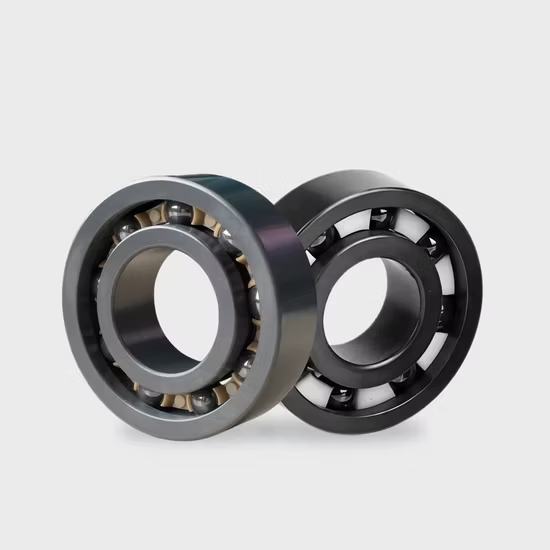
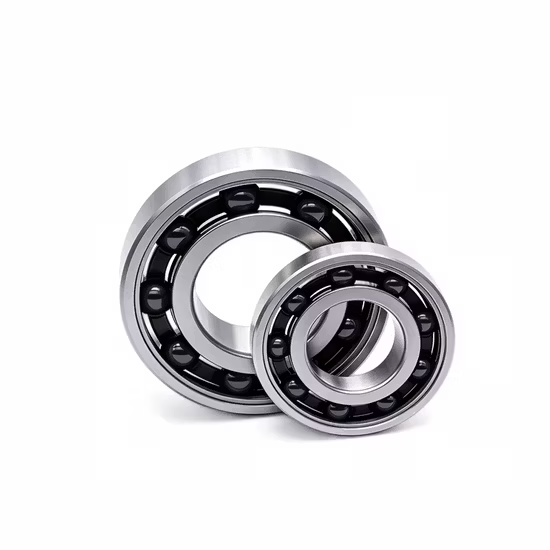
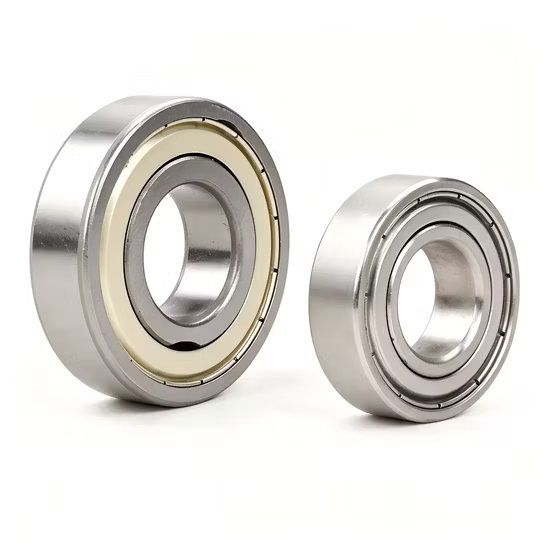
Cross-Reference Alignment Verified — Every high-temperature application review matches internal clearance, cage material, and precision class to the exact thermal profile, rather than relying solely on a base part number.
Technical Specifications
| Parameter |
Value |
| Product Type |
High Temperature Bearing |
| Material Options |
Bearing Steel, Stainless Steel, Ceramic Variants |
| Operational Features |
Corrosion Resistant, Antimagnetic, High Temperature, High Speed, Heavy Load, Heat Resistant |
| Certification |
RoHS, CE |
| Customization |
Available for non-standard dimensions and specific thermal profiles |
Application Suitability
| Industry |
Typical Applications |
| Steel and metallurgy |
Continuous casting machine roll bearings, cooling bed transfer chains |
| Cement |
Rotary kiln support rollers, clinker cooler grate plates |
| Glass manufacturing |
Annealing lehr conveyor chains, glass forming machine mechanisms |
| Industrial Machinery |
Industrial oven conveyor systems, paint curing line rollers |
Why Standard Bearings Seize in High-Heat Environments Before the Steel Yields
Thermal expansion outpaces standard internal clearances, causing the rolling elements to bind and fracture the cage long before the rings reach their yield strength.
In heavy industrial zones, I have seen kiln car wheels lock up completely because a standard clearance bearing was installed where thermal growth demanded extra internal space. Sourcing from a reliable high temperature heat resistant bearing supplier prevents these catastrophic stoppages by ensuring the internal geometry accommodates the specific heat profile of the equipment [NEED_CITE: thermal expansion effects on bearing internal clearance]. When the cage fails under these bound conditions, the resulting downtime costs far exceed the initial component savings.

Matching Material Options to Extreme Thermal Profiles
Selecting the correct high temperature heat resistant bearing supplier ensures access to material options that align with your specific operational environment. Bearing steel variants handle heavy loads well but require specialized heat treatment and high-temperature lubricants to survive beyond standard thermal limits. For environments combining extreme heat with corrosive byproducts or strict non-magnetic requirements, stainless steel or ceramic rolling element options provide substantially higher resistance to degradation. The right material choice prevents premature spalling and ensures the structural integrity of the raceways under continuous thermal cycling.
Navigating Load, Speed, and Lubrication in High-Heat Zones
High-heat applications drastically alter the viscosity of standard lubricants, leading to metal-to-metal contact if the relubrication intervals are not adjusted for thermal breakdown. Heavy radial loads combined with slow oscillating movements in kiln support rollers demand solid lubricants or specialized high-temperature greases that will not carbonize and block the rolling paths [NEED_CITE: lubrication failure modes in high-temperature rolling bearings]. Furthermore, thermal gradients across the inner and outer rings dictate the necessary internal clearance class; ignoring this differential expansion guarantees premature fatigue and catastrophic cage failure.
Decoding Material and Clearance Selection for Heat Resistance
The core engineering challenge in heat-resistant applications lies in balancing the base material with the operational clearance class. Bearing steel construction provides the necessary core toughness for heavy load applications, but it must be paired with C3 or C4 internal clearances to absorb the differential thermal expansion between the shaft and the housing. When operating at elevated temperatures, standard CN clearance will quickly vanish as the inner ring expands faster than the outer ring, leading to severe preload and thermal binding. Selecting the appropriate cage material—whether machined brass for high vibration or specialized polymers for specific speed ranges—is equally critical to prevent the cage from melting or fracturing under thermal stress [NEED_CITE: rolling bearing failure mode classification per ISO 15243].
The Hidden Costs of Ignoring Thermal Expansion Dynamics
Failing to account for the specific thermal expansion coefficients of the shaft and housing materials leads to unplanned downtime that disrupts entire production lines. When a bearing seizes due to vanished internal clearance, the resulting friction can weld the rolling elements to the raceway, causing catastrophic damage to the surrounding mechanical seals and shafts. This level of failure often voids equipment warranties and requires extensive machining to repair the damaged housings. Relying on ISO 281 life calculations without adjusting for high-temperature lubrication degradation results in a false sense of security regarding the component’s expected service life [NEED_CITE: ISO 281 bearing life calculation modifications for temperature].
Why Our Engineering Approach Secures Your High-Temperature Operations
We act as a high temperature heat resistant bearing supplier that prioritizes application-specific cross-referencing over simple catalog matching. Our technical team reviews the exact operating temperature and housing material to recommend the precise internal clearance class, preventing the thermal binding that plagues standard selections. We verify that the chosen cage material and lubrication strategy align with the specific speed and load profile of your kiln or oven conveyors. Every shipment includes full batch traceability, ensuring the metallurgical properties of the bearing steel meet the strict demands of continuous high-heat exposure. This rigorous validation process eliminates the risk of receiving counterfeit components with soft inner rings that collapse under heavy thermal loads.
Documentation & Authenticity
- Certificate of Conformity verifying the specific high-temperature heat treatment batch for the bearing steel.
- Original manufacturer batch and lot traceability linked to the production facility’s thermal processing records.
- Official brand app QR verification to confirm the authenticity of the heat-resistant material grades.
- Material test report detailing the metallurgical composition and high-temperature hardness retention.
- Dimensional and running accuracy inspection report confirming the specified C3 or C4 clearance class before dispatch.
Storage, Handling & Mounting Protocols
- Store the high-temperature bearing steel variants in their original vapor-phase inhibitor packaging to prevent surface oxidation before installation.
- Use induction heating for mounting inner rings on shafts, strictly avoiding open flames that could locally anneal the heat-treated raceways.
- Apply specialized high-temperature assembly pastes to prevent micro-welding during the initial run-in phase of oven conveyor rollers.
- Ensure ceramic rolling element options are handled with clean, lint-free gloves to prevent surface contamination that compromises heat resistance.
- Verify the housing bore diameter at the actual operating temperature to confirm the selected clearance class will not vanish during thermal expansion.
Initiating Your Technical Selection Review
To initiate the selection process, provide our engineering team with the specific equipment model, exact operating temperature range, and the thermal expansion characteristics of the surrounding housing materials. Supplying detailed load profiles—including radial, axial, and shock load magnitudes—allows us to calculate the required dynamic load rating and recommend the optimal material option. This data-driven approach ensures the final high temperature heat resistant bearing supplier recommendation perfectly aligns with your facility’s unique thermal and mechanical demands.
Frequently Asked Questions
Q: How do we determine the exact bearing designation for a custom high-heat application?
A: Provide the exact operating temperature, shaft and housing materials, and load parameters. Our engineering team uses this data to calculate the differential thermal expansion and select the precise internal clearance class, cage material, and base designation required to prevent thermal binding and ensure reliable operation in your specific high-heat environment.
Q: What are the most common failure modes for bearings in continuous high-temperature environments?
A: The most frequent failures involve thermal binding due to insufficient internal clearance, lubricant carbonization blocking the rolling paths, and cage fracture from thermal degradation. Sourcing from a qualified high temperature heat resistant bearing supplier ensures these failure modes are mitigated through precise clearance selection and specialized high-heat material options.
Q: How do bearing steel, stainless steel, and ceramic options compare for high-temperature use?
A: Bearing steel offers superior load capacity but requires specialized heat treatment and high-temperature lubricants. Stainless steel provides better corrosion resistance in humid, hot environments, while ceramic options deliver exceptional performance at extreme temperatures with significantly lower thermal expansion and reduced lubrication dependency.
Q: What customization options and minimum order quantities apply to non-standard high-heat sizes?
A: We offer dimensional customization, specialized clearance classes, and tailored cage materials for non-standard industrial oven and kiln applications. Minimum order quantities depend on the specific tooling required for the custom dimensions and the selected high-temperature material variant, which our team will clarify during the initial technical review.