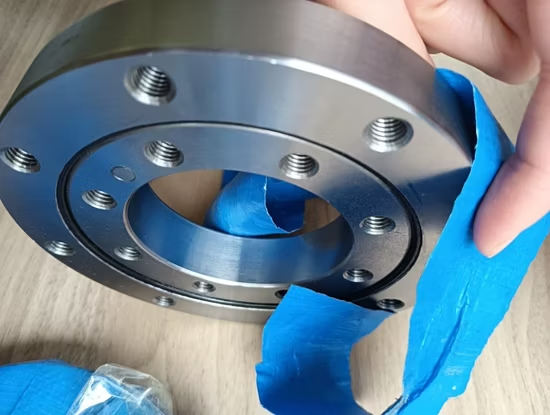
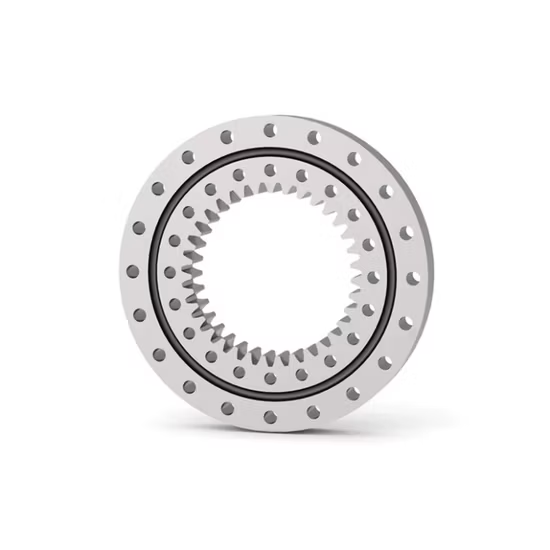
Unified Sourcing for Mixed Equipment — Procure customized large-diameter rotating components alongside standard precision parts in a single consolidated shipment without juggling multiple vendors.
Technical Specifications
| Parameter |
Value |
| Product Type |
Slewing Bearing |
| Material |
Bearing steel (available in stainless or specialized alloy variants) |
| Main Types |
Single-row, crossed roller, three-row roller |
| Key Structural Components |
Ring, rolling elements, sealing strip, spacer/cage |
| Core Features |
Large size, low speed, high load capacity |
| Specification |
Customized |
| Origin |
China |
Application Suitability
| Industry |
Typical Applications |
| Construction Machinery |
Crane slewing mechanisms, excavator rotating platforms |
| Automation Equipment |
Heavy-duty robotic positioning bases, automated assembly turntables |
| Wind Power |
Yaw and pitch control mechanisms for turbine nacelles |
Why Sourcing the Right Nonstandard Slewing Bearing Supplier Prevents Structural Binding
Matching the outer diameter and bolt hole pattern is never enough to prevent catastrophic structural binding under complex overturning moments.
In my years trading mechanical components out of Dongguan, I have seen heavily integrated machinery grind to a halt simply because a replacement ring matched the base envelope but ignored internal raceway geometry. When procurement teams rely solely on basic outline dimensions, the resulting mismatch in rolling element spacing or seal friction generates localized thermal binding [NEED_CITE: rolling bearing failure mode classification per ISO 15243]. A reliable nonstandard slewing bearing supplier ensures that every internal structural detail aligns perfectly with the actual operational loads.

Engineering Alignment for Complex Load Profiles
Selecting the correct configuration requires looking far beyond basic footprint dimensions. As a specialized nonstandard slewing bearing supplier, we evaluate the exact combination of axial forces, radial loads, and overturning moments your equipment generates. This deep technical review ensures the internal geometry and rolling element distribution are optimized for your specific structural integration requirements.
Navigating Low-Speed and High-Load Environments
Rotating platforms in heavy machinery operate under extreme pressure at very low rotational speeds, which prevents the formation of a full hydrodynamic lubrication film. This boundary lubrication regime demands precise surface finishes and specialized sealing strips to keep abrasive construction dust out while minimizing rotational friction. Inadequate sealing or improper spacer design in these conditions rapidly accelerates raceway wear and compromises the entire structural assembly [NEED_CITE: impact of boundary lubrication on large diameter bearings].
Decoding Structural Options and Material Variants
The choice between single-row, crossed roller, and three-row roller designs dictates how the component handles multi-directional forces. Crossed roller arrangements excel at resisting complex tilting moments in compact spaces, while three-row structures manage massive independent axial and radial loads. While high-purity bearing steel is standard for maximum fatigue resistance, alternative materials like stainless steel variants are available for environments with high moisture or corrosive exposure.
The Hidden Costs of Incorrect Selection
Installing a ring with mismatched internal clearances or inadequate load distribution leads to uneven stress concentrations across the raceway. This localized overloading causes premature spalling and eventual structural cracking, resulting in unplanned downtime and catastrophic damage to the host machinery. Such failures routinely void equipment warranties and necessitate complete teardowns to replace the compromised component [NEED_CITE: structural failure mechanisms per ISO 281].
Why Procurement Teams Rely on Our Technical Review
Our cross-brand interchange process verifies internal raceway profiles and seal geometries, not just outer dimensions. We provide batch traceability for every customized unit, ensuring full material transparency from the manufacturer’s production facilities. Our engineering team reviews your specific load and speed parameters to recommend the exact roller arrangement. This rigorous technical validation eliminates the guesswork and prevents the costly field failures caused by superficial cross-referencing.
Documentation & Authenticity
- Certificate of Conformity validating the specific customized dimensions and structural type.
- Original factory batch traceability linking the large-diameter ring to its specific heat treatment lot.
- Material test reports confirming the metallurgical properties of the bearing steel used.
- Dimensional and running accuracy inspection reports verifying tolerances before dispatch.
- Country-of-origin documentation required for international customs and project compliance.
Storage, Handling & Mounting
- Keep the customized sealing strips intact in original packaging to prevent dust ingress before installation.
- Use clean lifting slings to avoid damaging the precision-machined outer rings during heavy equipment hoisting.
- Verify the specific bolt hole pattern alignment before applying final torque to prevent structural distortion.
- Apply the recommended grease type through the designated fittings to protect the rolling elements immediately after mounting.
Preparing Your Technical Inquiry
To ensure accurate selection, please provide the exact equipment model, available mounting space, and the maximum expected axial, radial, and tilting loads. Detailing the operating environment, including exposure to dust, moisture, or extreme temperatures, allows our engineering team to determine the optimal material and structural configuration for your application.
Frequently Asked Questions
Q: How do you determine the correct structural type for complex load conditions?
A: We analyze the specific combination of axial, radial, and overturning moments your equipment generates. By evaluating these compound forces alongside the available mounting space and rotational speed, our engineering team determines whether a single-row, crossed roller, or three-row configuration provides the most reliable structural support.
Q: What are the common failure modes for customized rotating components?
A: Premature failures typically stem from inadequate sealing allowing abrasive ingress, or internal geometries that fail to distribute complex overturning moments evenly. These issues lead to localized raceway spalling and structural binding, which we prevent through rigorous application-based selection and precise internal clearance matching.
Q: How can we safely replace an obsolete original equipment component?
A: Our team conducts a comprehensive dimensional and operational mapping of the existing unit. We verify the exact envelope dimensions, internal load distribution requirements, and mounting interfaces to engineer a fully compatible alternative that restores original equipment performance without requiring structural modifications to the host machinery.
Q: What is the selection boundary between crossed roller and three-row designs?
A: Crossed roller structures are ideal for applications requiring high rigidity and resistance to complex tilting moments within a compact cross-section. Conversely, three-row designs are specified when the equipment generates massive, independent axial and radial loads that require separate, dedicated rolling element paths to maintain structural stability.

![Custom Nonstandard Slewing Bearing for High Structural Integration [WARN] draft identifier mismatch](https://skfid.com/wp-content/uploads/2026/09/custom-nonstandard-slewing-bearing-for-high-structural-integration-warn-draft-identifier-mismatch-872e48.avif)