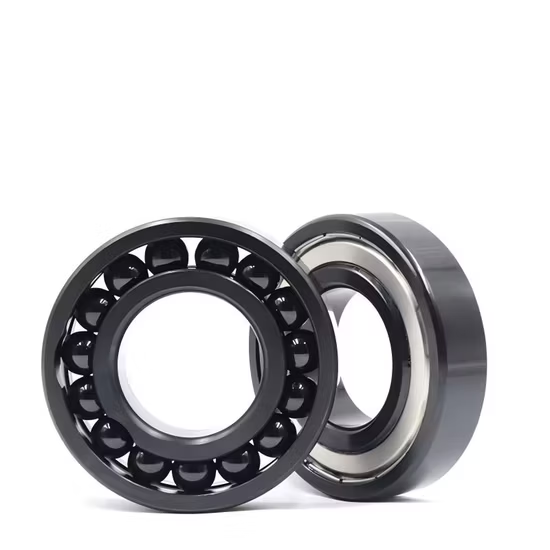
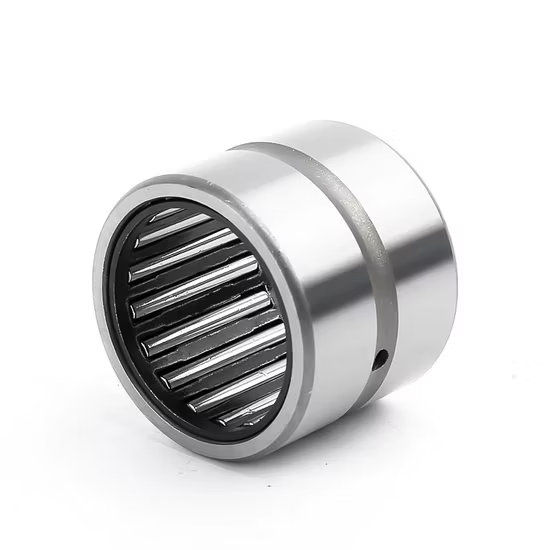
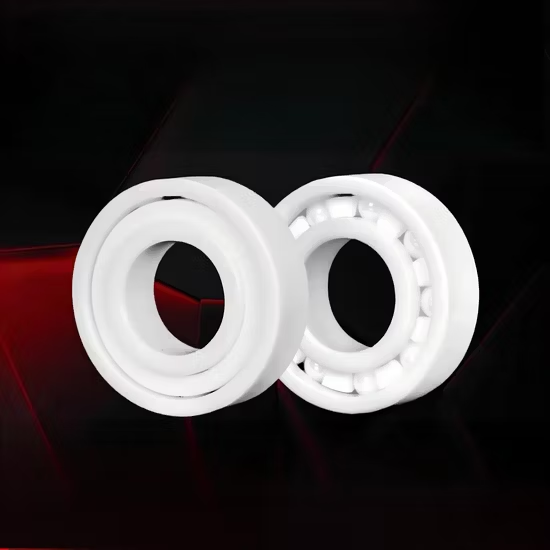
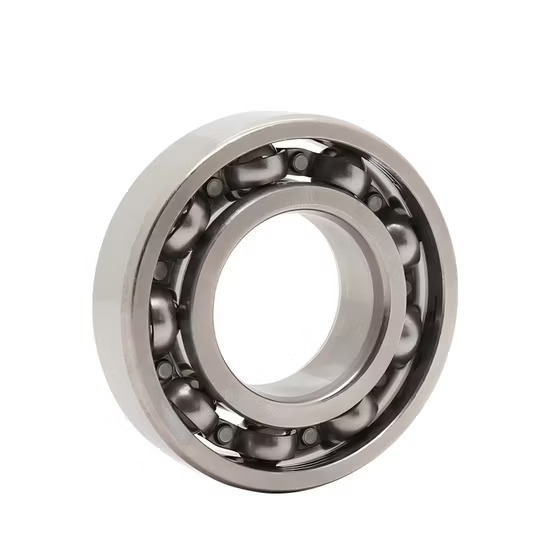
Cross-reference alignment verified — We match thermal limits, cage materials, and internal clearances rather than just base dimensions, ensuring your equipment survives extreme heat without binding.
Technical Specifications
| Parameter |
Value |
| Product Type |
High Temperature Bearing |
| Operating Temperature Range |
300-1000℃ |
| Key Features |
Corrosion Resistant, Antimagnetic, High Speed |
| Material Options |
Customized alloys and ceramics available |
| Certification |
RoHS, CE |
| Customization |
Full OEM/ODM support |
| Application Scope |
Industrial Equipment, Kiln Cars, Bakery Ovens |
Application Suitability
| Industry |
Typical Applications |
| Steel & Metallurgy |
Reheating furnace transfer cars, continuous casting guide rollers |
| Glass Manufacturing |
Annealing lehr conveyors, forming machine articulation joints |
| Food Processing |
Industrial bakery oven trolley wheels, continuous fryer chains |
| General Industrial |
High-temperature exhaust fans, exhaust damper actuators |
Why Standard Replacements Fail Before the Steel Melts
Sourcing from a qualified high temperature industrial bearing supplier is critical because standard catalog parts simply disintegrate in extreme heat zones.
Standard bearing steel loses structural integrity and lubricants carbonize long before the metal actually melts.
I have seen procurement teams try to save money by installing standard deep groove bearings inside kiln car assemblies. Within days, the standard grease bakes into a solid carbon block, and the mild steel cage softens and collapses under the radial load. The resulting seizure tears the shaft journal and halts the entire production line [NEED_CITE: thermal degradation of standard lubricants and cage materials]. True high-heat components require specialized metallurgy and dry-film treatments that standard inventory simply does not possess.

Matching Metallurgy to the Thermal Profile
Selecting the right high temperature industrial bearing supplier means securing access to customized material matrices. Standard martensitic steels lose their hardness rapidly when pushed beyond their tempering thresholds. For operations hovering around the lower end of the 300-1000℃ spectrum, specialized heat-stabilized alloy variants are necessary to maintain dimensional stability. As temperatures climb toward the extreme upper limits, the design must transition toward advanced ceramic rolling elements or specialized high-temperature alloys. These customized material options ensure that the raceways and rolling elements resist thermal softening, preventing the catastrophic plastic deformation that plagues incorrectly specified components.
Navigating Extreme Thermal and Mechanical Stresses
Equipment operating in these environments faces* thermal cycling. The massive temperature gradients cause uneven thermal expansion between the shaft, the housing, and the bearing rings [NEED_CITE: thermally induced internal clearance reduction in mounted bearings]. If the internal geometry is not specifically engineered to accommodate this expansion, the components will bind and generate immense friction heat. Furthermore, standard contact seals will instantly melt or carbonize, meaning these setups often rely on specialized non-contact shields or open designs paired with external dry-film lubrication to keep abrasive kiln dust out without creating drag.
Decoding Material and Clearance Selection
The core engineering challenge lies in balancing the initial internal clearance with the expected operational temperature delta. A standard clearance class will inevitably lead to thermal binding as the inner ring expands faster than the outer ring. Therefore, customized high-temperature variants are manufactured with significantly expanded internal geometries to absorb this thermal growth. Additionally, the choice between specialized alloy steels, stainless variants for combined corrosion resistance, or full ceramic constructions depends entirely on the presence of moisture, corrosive gases, or magnetic fields in the specific furnace zone. The RoHS and CE certifications ensure that whatever customized material matrix is selected, it meets strict environmental and safety compliance standards for global industrial equipment integration.
The Hidden Costs of Incorrect Thermal Specifications
Ignoring the specific thermal limits of your application leads to catastrophic unplanned downtime. When a standard component seizes inside a glass annealing lehr or a steel mill transfer car, the resulting shaft damage often requires a complete assembly teardown. According to failure analysis frameworks like ISO 15243, thermal discoloration and cage smearing are direct indicators of lubrication failure and excessive operating temperatures [NEED_CITE: rolling bearing failure mode classification per ISO 15243]. This premature failure not only destroys the component but also voids equipment warranties and causes massive secondary damage to surrounding machinery.
Why Our Engineering Approach Protects Your Line
We differentiate ourselves by treating every inquiry as a complex thermal engineering problem rather than a simple part swap. When buyers request high-heat components, we rigorously cross-reference the application’s peak temperature against the specific material limits, ensuring we never supply a part that will soften under load. Our batch traceability guarantees that the customized alloy or ceramic composition you receive exactly matches the material test reports, eliminating the risk of receiving downgraded counterfeit metals. Furthermore, our application-based selection review covers the thermal expansion coefficients of your specific shaft and housing materials, ensuring the selected clearance class prevents binding at peak operating temperatures.
Documentation & Authenticity
- Certificate of Conformity verifying the specific customized alloy or ceramic composition used in your batch.
- Material test reports detailing the exact heat treatment and thermal stability limits of the rings and rolling elements.
- Dimensional and running accuracy inspection reports confirming the expanded internal clearances required for high-heat operation.
- Batch and lot traceability linking every component back to the manufacturer’s specific production run.
- RoHS and CE compliance documentation ensuring your high-temperature equipment meets international export standards.
Storage, Handling & Mounting
- Keep customized high-temperature variants in original packaging until mounting to prevent moisture ingress that compromises dry-film coatings.
- Use clean, lint-free gloves when handling ceramic rolling elements to prevent skin oils from affecting high-speed thermal performance.
- Verify the expanded internal clearance class matches the thermal expansion profile of your specific shaft material before pressing.
- Avoid using standard carbon steel tools on antimagnetic or stainless high-heat variants to prevent cross-contamination and surface rust.
- Follow specialized induction heating protocols for inner rings, ensuring temperatures do not exceed the specific alloy’s tempering limits.
Initiating Your Technical Review
To ensure we specify the exact customized configuration for your machinery, please provide the peak continuous operating temperature, the specific radial and axial loads, and the rotational speed. Detailing the environmental factors, such as exposure to corrosive gases or abrasive kiln dust, allows our engineering team to select the optimal material matrix and sealing arrangement. Supplying the exact equipment model or OEM drawings enables us to perform a comprehensive cross-reference and confirm the necessary thermal clearance adjustments.
Frequently Asked Questions
Q: How do you determine the exact material and model for extreme heat applications?
A: We analyze your peak operating temperature, rotational speed, and specific load profiles to select the optimal customized material matrix. By evaluating the thermal expansion characteristics of your shaft and housing, we calculate the precise internal clearance required to prevent thermal binding, ensuring the final configuration is perfectly matched to your unique industrial environment.
Q: What are the most common failure modes in high-heat environments and how are they prevented?
A: Standard components typically fail due to lubricant carbonization, cage softening, and thermal binding. We prevent these issues by specifying bearings with specialized dry-film treatments, high-temperature alloy or ceramic cages, and expanded internal clearances. This engineered approach ensures the components maintain structural integrity and slide smoothly even when standard greases would bake into solid carbon blocks.
Q: How do standard steel, stainless, and ceramic options differ in extreme heat?
A: Standard steels lose hardness rapidly beyond their tempering limits, while stainless variants offer better corrosion resistance but share similar thermal ceilings. Full ceramic constructions maintain exceptional dimensional stability and hardness at the extreme upper end of the 300-1000℃ range. We guide you through these customized options to find the exact balance of thermal endurance and mechanical load capacity your application demands.
Q: What information is needed to safely cross-reference an obsolete high-temperature part?
A: We require the original equipment manufacturer’s part number, the exact operating temperature range, and the specific environmental conditions. Simply matching the base dimensions is dangerous; we cross-reference the internal clearance, cage material, and thermal limits to ensure the replacement customized bearing will not seize or deform under your specific operational stresses.