
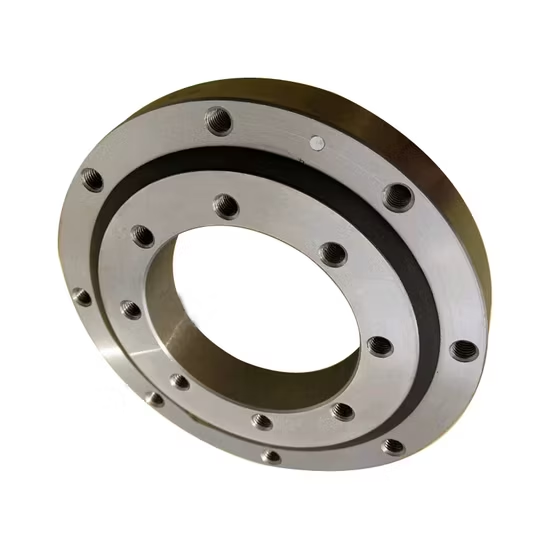
Industrial Slewing Bearing with Reinforced Cage Design
View Details
SKF
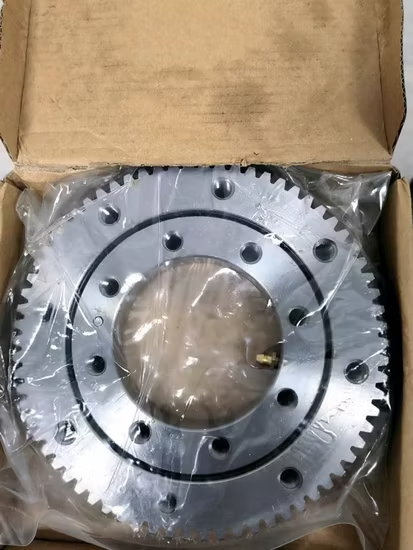
-- SKF Authorized Engineering Partner
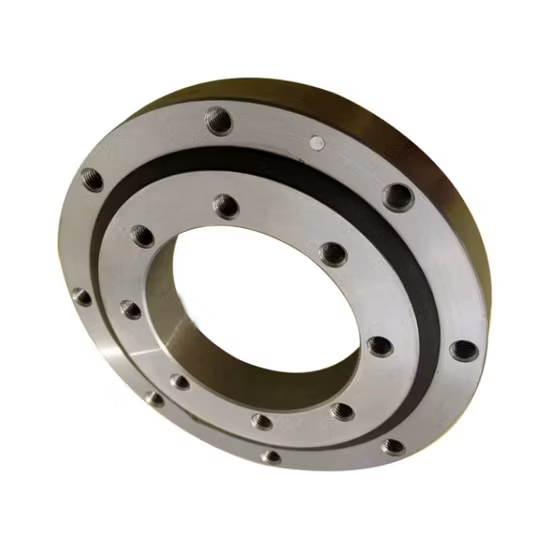
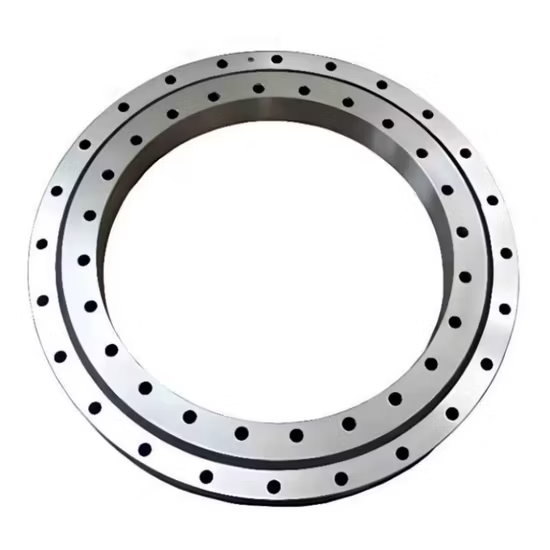
Crossed Roller Slewing Bearing for Construction Machinery and Automation — premium bearing steel construction engineered for low-speed, high-load rotating platforms.
15+ Certified Engineers On-Call
Free application analysis · Failure diagnosis · Custom modification guidance. Response within 24 hours.
Unified Multi-Brand Sourcing — One consolidated shipment covers all major international bearing brands alongside your customized slewing rings, eliminating multi-vendor coordination delays.
| Parameter | Value |
|---|---|
| Product Type | Crossed Roller Slewing Bearing |
| Material Options | Bearing Steel, Stainless Steel, Ceramic Variants |
| Structural Types | Single-Row, Crossed Roller, Three-Row Roller |
| Key Structural Components | Ring, Rolling Elements, Sealing Strip, Spacer/Cage |
| Core Features | Large Size, Low Speed, High Load Capacity |
| Customization | Fully Customized Dimensions and Mounting Holes |
| Origin | China |
| Industry | Typical Applications |
|---|---|
| Construction Machinery | Excavator upper structure rotation, crane slewing mechanisms, concrete pump truck booms |
| Automation & Robotics | Heavy-duty robotic arm bases, automated guided vehicle turntables, precision indexing tables |
| Renewable Energy | Wind turbine yaw and pitch control mechanisms |
| Material Handling | Stacker reclaimer rotation joints, radial stacker conveyors |
Premature failure usually stems from cross-reference errors that ignore internal geometry and sealing designs, not from inadequate steel strength.
Procurement teams often match the base outer diameter and bolt circle, overlooking the specific internal clearance, cage material, or seal type required for the actual operating environment. I have seen heavy-duty rotating platforms seize completely under high ambient temperatures simply because a standard clearance ring was installed where a thermally expanded clearance was mandatory. When a crossed roller slewing bearing supplier provides a component that matches the basic envelope dimensions but fails to account for the dynamic tilting moments and thermal expansion of the specific machinery, the resulting internal binding leads to catastrophic cage failure and unplanned downtime [NEED_CITE: rolling bearing failure mode classification per ISO 15243].
Selecting the correct internal arrangement is critical for managing the multi-directional forces present in heavy equipment. As an experienced crossed roller slewing bearing supplier, we evaluate the exact ratio of axial loads, radial loads, and overturning moments to recommend the optimal configuration. Crossed roller designs excel in applications demanding high rigidity and precise rotation under combined loads, while three-row roller structures are deployed when massive static and dynamic tilting moments dominate the operational profile.
The operational environment for large-scale rotation mechanisms imposes severe demands on component integrity. These applications typically involve very low rotational speeds combined with extreme shock loads and continuous oscillating movements, which prevent the formation of a stable hydrodynamic lubrication film. Consequently, boundary lubrication conditions prevail, making the selection of extreme-pressure lubricants and robust sealing strips essential to prevent abrasive particle ingress. Furthermore, the structural deflection of the host machinery under peak loading can distort the bearing rings, necessitating precise mounting surface tolerances to avoid localized stress concentrations that accelerate raceway spalling [NEED_CITE: structural deflection effects on slewing bearing raceways per ISO 281].
The longevity of the rotation mechanism depends heavily on selecting the right material and structural options for the specific environment. While standard bearing steel provides the necessary core hardness and load-bearing capacity for most general construction applications, stainless steel variants are available for environments exposed to moisture or corrosive chemicals. Ceramic rolling element options can be specified to mitigate electrical erosion or reduce rotational inertia in high-precision automation setups. The choice between integrated sealing strips and external labyrinth seals must balance the need for contamination exclusion against the friction torque limitations of the drive motor.
Specifying a ring based solely on dimensional interchangeability without verifying the internal load distribution leads to severe operational consequences. When the rolling elements and raceways are subjected to localized overloading due to improper structural selection, the resulting surface fatigue causes premature spalling and excessive rotational play. This degradation compromises the positioning accuracy of automated machinery and induces severe vibrations in crane booms, ultimately resulting in catastrophic mechanical damage, voided equipment warranties, and extended project delays that far exceed the initial component savings [NEED_CITE: economic impact of unplanned downtime in heavy machinery per ISO 15243].
Our technical review process actively prevents the common pitfalls associated with large-diameter rotation components. We verify that the internal clearance and rolling element sizing align perfectly with the thermal and mechanical deflection characteristics of your specific host structure. By providing comprehensive cross-brand interchange analysis, we ensure that replacement units maintain the exact load-carrying geometry required by the original equipment manufacturer. Every customized specification is backed by rigorous dimensional verification, ensuring that mounting hole alignments and gear tooth profiles integrate flawlessly with your existing drive systems.
To ensure the customized rotation mechanism perfectly aligns with your operational requirements, please provide the detailed equipment parameters, including the maximum axial and radial loads, peak overturning moments, and rotational speed profiles. Supplying the original equipment manufacturer drawings or detailed dimensional constraints allows our engineering team to calculate the required static and dynamic safety factors. Additionally, specifying the environmental conditions, such as exposure to abrasive dust or corrosive elements, enables us to finalize the optimal material and sealing configuration for your application.
Q: How do we determine the exact structural type required for our specific overturning moments?
A: Determining the correct structure requires analyzing the maximum axial, radial, and overturning moment loads your equipment generates. Crossed roller designs are ideal for high rigidity and combined loads, while three-row configurations handle massive tilting moments. Providing your complete load spectrum allows our engineering team to calculate the necessary safety factors and recommend the precise structural geometry.
Q: What are the most common failure modes in automation and heavy machinery rotation joints?
A: Premature failures typically stem from inadequate structural rigidity causing ring distortion, or improper sealing allowing abrasive ingress. In automation, insufficient internal rigidity leads to positioning errors, while in heavy machinery, localized raceway overloading causes spalling. We address these by verifying host structure flatness and specifying robust sealing strips matched to the exact environmental contamination levels.
Q: How do we confirm machining tolerances and minimum order quantities for non-standard dimensions?
A: For non-standard dimensions, we review your specific mounting space and load requirements to establish the necessary machining tolerances for the rings and gear teeth. Once the technical drawings are approved, we provide a clear quotation detailing the production lead time and minimum order quantities. Every custom unit is accompanied by comprehensive dimensional inspection reports verifying the final machined specifications.
Q: What lubrication practices are recommended for low-speed, high-load oscillating applications?
A: Low-speed oscillating applications struggle to maintain a full hydrodynamic lubrication film, making boundary lubrication critical. We recommend using high-viscosity, extreme-pressure greases with solid additives like molybdenum disulfide. Establishing a frequent, automated relubrication schedule ensures fresh grease continuously purges contaminants and maintains the protective boundary layer across the heavily loaded rolling elements and raceways.
Q: How can we quickly execute a replacement selection when original equipment faces unexpected downtime?
A: During unexpected downtime, provide the original equipment manufacturer part number, detailed dimensional constraints, and actual operating loads. Our team performs a comprehensive cross-reference analysis that goes beyond basic outer dimensions, verifying internal clearances, gear profiles, and sealing types. This ensures the replacement unit integrates perfectly and restores full operational reliability without requiring structural modifications.
Main shaft, gearbox, and generator bearings for onshore and offshore wind turbines. Engineered for 20+ year service life.
Crushers, conveyors, and processing equipment bearings designed to withstand shock loads and contaminated environments.
Rolling mill and continuous casting bearings rated for extreme temperatures, heavy loads, and aggressive lubricants.
Hub units, transmission, and electric motor bearings meeting TS 16949 requirements for passenger and commercial vehicles.
Machine tool spindle and robotics bearings with P4/P2 accuracy class for ultra-precise positioning and minimal vibration.
Pumps, fans, compressors, and conveyor systems across all manufacturing sectors requiring reliable, cost-effective bearing solutions.
Official partner since 1998 with direct access to SKF technical resources, genuine products, and engineering expertise.
In-house team provides application design, failure analysis, and predictive maintenance -- reducing bearing failures by 35%.
Every product undergoes rigorous pre-shipment inspection with full documentation for traceability and compliance.
Dedicated account managers and reliable delivery networks ensure on-time supply for enterprise clients worldwide.
Performance Metrics
35%
Failures Prevented
70%
Downtime Reduction
25+
Years Experience
24h
Quote Response
78% of large enterprises prefer suppliers offering integrated technical support and lifecycle services.
Custom bearing selection and system design based on your specific load conditions, speeds, temperatures, and environmental factors.
Root-cause investigation of bearing failures using metallurgical testing, vibration analysis, and operating data review.
IIoT-enabled monitoring with smart sensor bearings for real-time vibration, temperature, and RPM tracking.
Modified bearings with special coatings, seals, tolerances, or materials. Lead time 8-12 weeks from official channels.
Certified engineers available for on-site installation support, alignment checks, and commissioning assistance worldwide.
Long-term service agreements including regular maintenance checks, replacement scheduling, and performance reporting.
Free samples available for orders over $50K
Validated against your KPIs before full production commitment.
-- Get In Touch
Our certified engineers will review your application requirements and provide a detailed quote within 24 hours.
Address
No. 377 Bansongyuan Road, Huangpu District, Shanghai, China
Free Sample Program
Orders over $50K qualify for free product samples
Test against your KPIs before full production commitment. Ask our engineers for details.
Regarding: Custom Crossed Roller Slewing Bearing for Construction Machinery and Automation
-- Related Products
![Custom Crossed Roller Slewing Bearing for Machinery [WARN] draft identifier mismatch](https://skfid.com/wp-content/uploads/2026/09/custom-crossed-roller-slewing-bearing-for-machinery-warn-draft-identifier-mismatch-44984d.avif)
SKF Authorized Engineering Partner
Need technical support or a custom solution?
15+ certified engineers ready to help. Response within 24 hours.